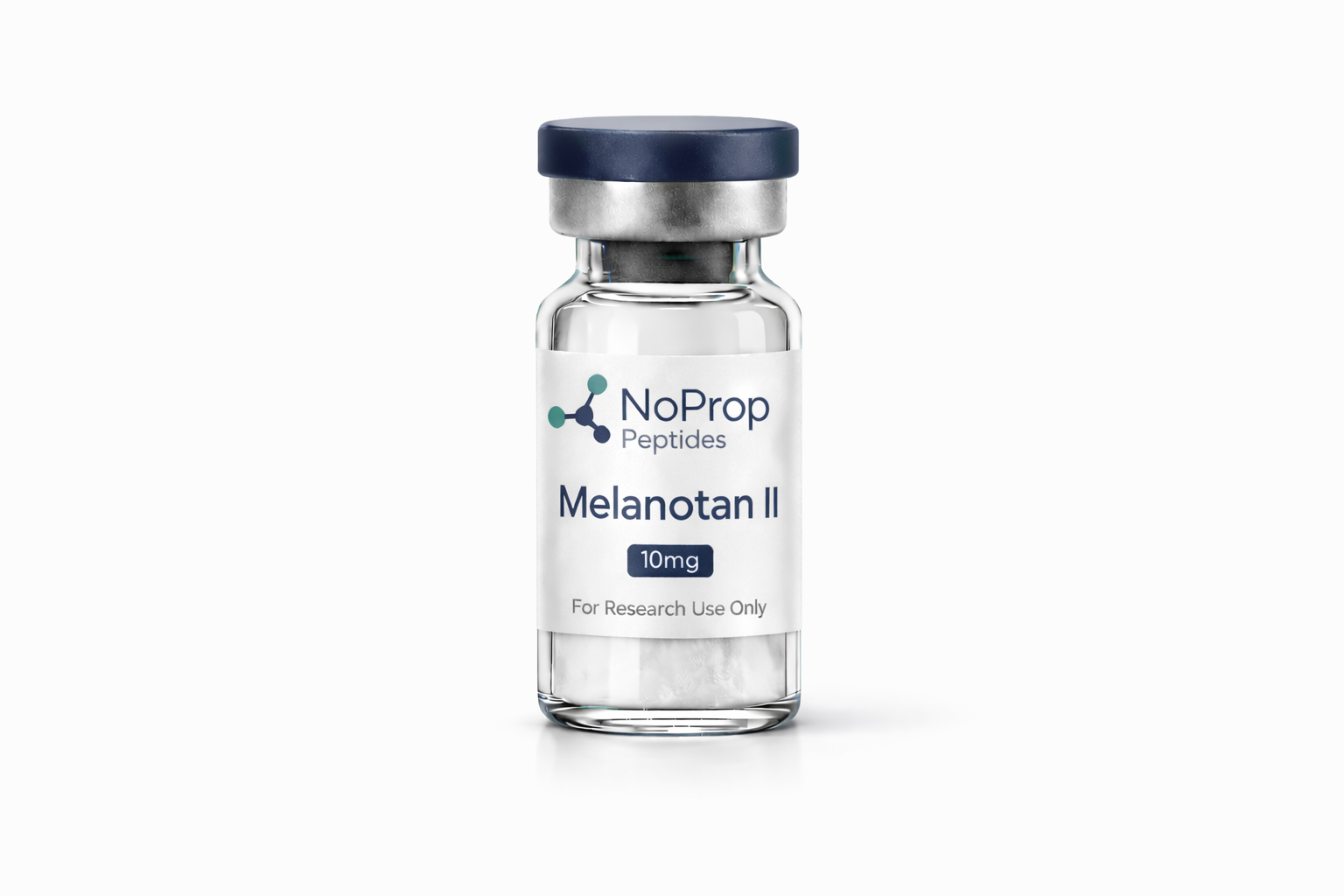
Melanotan II
$34.99
Research-grade Melanotan II tanning peptide. 99%+ purity, third-party tested. 10mg per vial.
Description
Melanotan II is a cyclic heptapeptide analog of alpha-melanocyte-stimulating hormone (α-MSH), developed at the University of Arizona in the early 1990s. Designed to activate melanocortin receptors (MC1R through MC5R), Melanotan II produces its effects through broad receptor binding — which accounts for both its tanning activity and the range of additional biological effects observed in research.
Research Profile
Melanotan II’s primary researched mechanism involves MC1R activation on melanocytes, stimulating eumelanin production and distribution independent of UV exposure. However, its non-selective binding profile means it simultaneously activates MC3R and MC4R — receptors involved in energy homeostasis and sexual function respectively. The sexual arousal side effects observed during clinical trials led directly to the development of PT-141 (Bremelanotide) as a more targeted compound.
Key Research Areas
- Melanogenesis and UV-independent tanning mechanisms
- MC1R-mediated photoprotection research
- Melanocortin receptor binding and selectivity studies
- Energy homeostasis via MC3R/MC4R pathways
- Comparative studies with selective melanocortin agonists
Specifications
| Sequence | Ac-Nle-c[Asp-His-D-Phe-Arg-Trp-Lys]-NH₂ |
| Molecular Weight | 1024.18 g/mol |
| Purity | ≥99% (HPLC verified) |
| Form | Lyophilized powder |
| Quantity | 10mg per vial |
| Storage | -20°C pre-reconstitution / protect from light |
Related Research Peptides
PT-141 (Bremelanotide) was derived from Melanotan II to isolate the MC4R sexual health activity. For broader peptide research, explore our complete peptide catalog.
Research Dosage Protocols
Melanotan II research uses two general protocol structures: loading-phase pigmentation studies and acute-dose arousal/appetite research. Loading protocols in animal studies typically start at 0.1mg/kg per dose, administered daily for 1–2 weeks, followed by maintenance at lower frequency. Acute arousal response studies use single doses of 0.025–0.1mg/kg. A 10mg vial reconstituted in 2mL bacteriostatic water yields 5,000mcg/mL. MT-II is light-sensitive — store in amber vials and protect from UV exposure. Refrigerate at 2–8°C post-reconstitution with a 4-week working window. The loading vs. maintenance protocol structure in pigmentation research reflects the cumulative, sustained nature of melanogenesis versus the transient nature of arousal effects.
Frequently Asked Questions
What does “non-selective melanocortin receptor binding” mean for MT-II research?
Melanotan II binds MC1R, MC3R, MC4R, and MC5R with high affinity — it is a potent agonist across the melanocortin receptor family. This broad receptor activation is why MT-II produces multiple simultaneous effects: pigmentation (MC1R on melanocytes), reduced appetite and metabolic effects (MC3R and MC4R in hypothalamus), sexual arousal (MC4R in hypothalamus), and exocrine gland effects (MC5R). Non-selectivity is the core challenge in clinical development — each effect rides on the same receptor family. Research using MT-II as a tool must acknowledge that observed effects may be mediated by multiple receptor subtypes simultaneously, which complicates attributing specific biological outcomes to a single receptor.
Is UV exposure still required for pigmentation with MT-II?
MT-II stimulates melanogenesis — the production and distribution of melanin within melanocytes — by activating MC1R. However, melanin production is a cellular process that still occurs more robustly when supported by UV-induced keratinocyte signaling that amplifies MC1R activation. Research shows MT-II produces some baseline melanin stimulation in the absence of UV, but the tanning response is substantially greater with concurrent UV exposure. In photoprotection research, MT-II has been studied specifically for its ability to build melanin prior to UV exposure, providing photoprotection for UV-sensitive individuals. The “does it work without UV” question depends on whether the endpoint is absolute melanin increase (yes) or clinical-grade tanning visible response (UV enhances this significantly).
How does MT-II relate to PT-141 in terms of mechanism and development?
PT-141 (bremelanotide) was directly derived from MT-II. During MT-II clinical development at the University of Arizona, researchers studying the tanning peptide serendipitously observed potent sexual arousal effects in trial participants. Investigation traced this to MC4R activation. PT-141 was then designed by modifying MT-II’s structure to reduce MC1R (pigmentation) and MC3R/MC5R activity while preserving MC4R (arousal) selectivity. MT-II is the broader-acting parent compound; PT-141 is a MC4R-focused derivative carved out of MT-II’s receptor profile. Researchers studying specific receptor contributions to behavior can use both as comparative tools to dissect MC4R versus pan-MCR effects.
How was nausea managed in early MT-II research?
Nausea was the primary dose-limiting adverse effect in MT-II human trials, reported by the majority of subjects at doses above 0.025mg/kg. The mechanism is MC4R activation in the area postrema (the vomiting center in the brainstem) — the same receptor mediating desired effects. Early research teams used slow intravenous infusion instead of bolus dosing to reduce peak plasma concentrations and attenuate nausea. Antiemetics (ondansetron, metoclopramide) were evaluated as pre-treatments. Dose escalation protocols starting well below the tanning-effective dose were used to allow receptor adaptation. These strategies reduced but didn’t eliminate nausea, which was a significant factor in MT-II not advancing as a pharmaceutical product.
How do I reconstitute MT-II, and why is light protection important?
Add 2mL bacteriostatic water to a 10mg MT-II vial for 5,000mcg/mL. MT-II dissolves readily. Critically, MT-II contains a tryptophan residue that undergoes photo-oxidation when exposed to UV or ambient light — this is true of the lyophilized powder and even more true of the reconstituted solution. Use amber vials, wrap in foil, or minimize exposure time during preparation. Store lyophilized powder at -20°C in the dark; store reconstituted solution at 2–8°C in amber vials with foil covering. Visual inspection for clarity isn’t sufficient — oxidized MT-II can appear clear while having degraded. For critical quantitative studies, use freshly aliquoted doses rather than working from a single vial over weeks.
What is a loading vs. maintenance protocol in MT-II pigmentation research?
Loading protocols in pigmentation research use daily dosing over 1–2 weeks to saturate MC1R and build melanin stores progressively. Melanogenesis requires sustained MC1R activation because melanin production is a multi-step enzymatic process (tyrosine → DOPA → dopaquinone → melanin) with a lag between receptor activation and measurable pigmentation change. The loading phase establishes baseline melanin elevation. Maintenance dosing (lower frequency, often 2–3x weekly) sustains melanin levels once loading is complete. This structure mirrors photoprotective research designs where the question is maximum achievable pigmentation (loading) versus the minimum dose needed to maintain that level (maintenance). Acute dose studies examining arousal or appetite don’t use this structure.
For research and laboratory use only. Not for human consumption. All peptides are sold strictly as research chemicals.