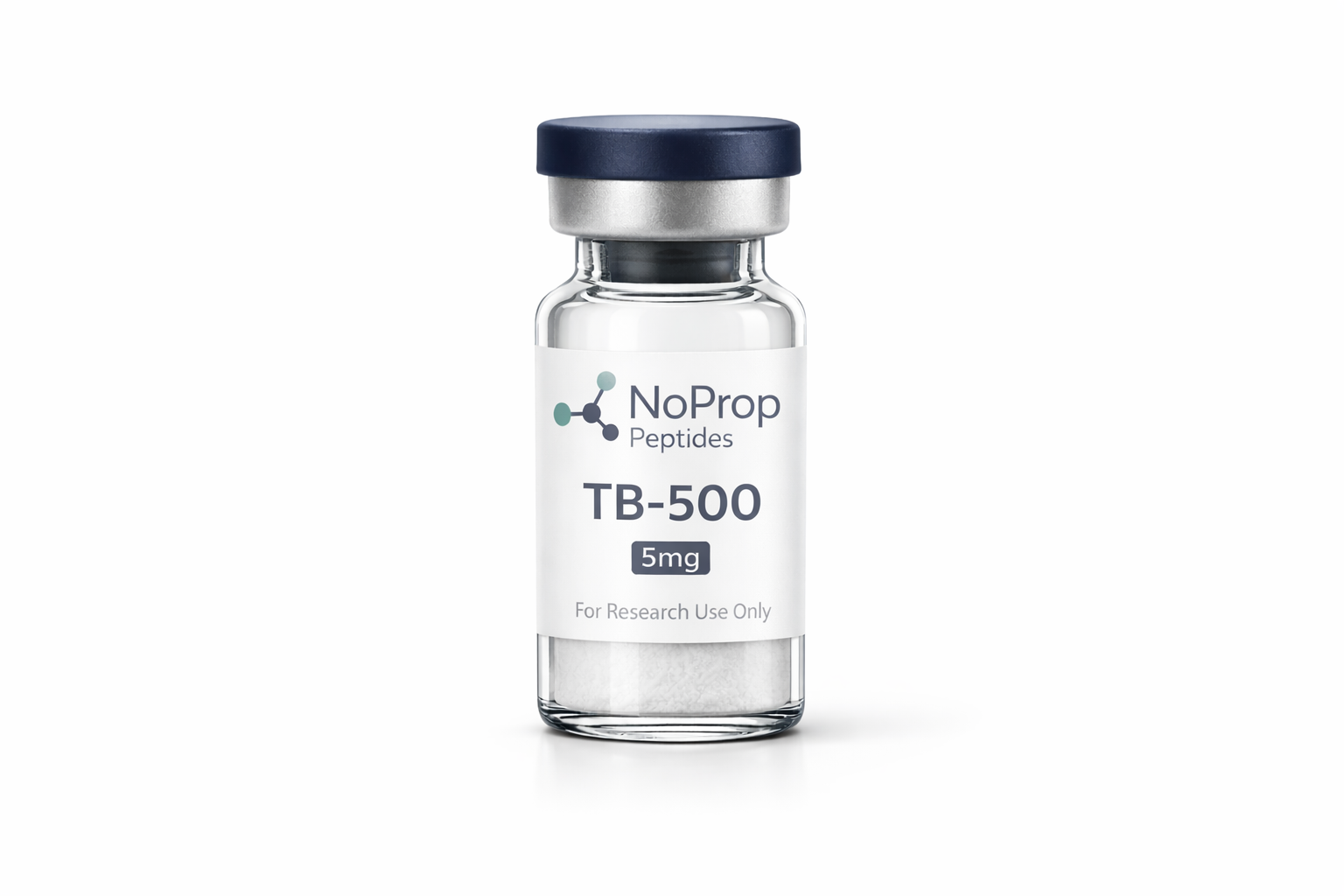
TB-500
$88.00
Research-grade TB-500 (Thymosin Beta-4 fragment). 99%+ purity, third-party tested. 5mg per vial.
Description
TB-500 is a synthetic version of the naturally occurring 43-amino acid peptide Thymosin Beta-4 (Tβ4). Found in virtually all human and animal cells, Thymosin Beta-4 plays a central role in actin regulation — the protein responsible for cell structure, motility, and division.
Research Profile
TB-500’s primary research interest lies in its ability to promote cell migration through interaction with actin. Unlike many peptides limited to localized activity, TB-500’s low molecular weight and unique structure allow systemic distribution — reaching damaged tissue regardless of injection proximity. This property has made it a focal point in wound healing and recovery research since the early 2000s.
Key Research Areas
- Upregulation of actin and cell migration pathways
- Reduction of inflammatory markers at injury sites
- Cardiac tissue repair following ischemic events
- Hair follicle stem cell stimulation
- Flexible joint and soft tissue recovery
Specifications
| Molecular Formula | C₂₁₂H₃₅₀N₅₆O₇₈S |
| Molecular Weight | 4963.44 g/mol |
| Purity | ≥99% (HPLC verified) |
| Form | Lyophilized powder |
| Quantity | 5mg per vial |
| Storage | -20°C pre-reconstitution / 2-8°C post-reconstitution |
Third-Party Testing
Each batch undergoes independent HPLC purity testing and mass spectrometry verification. Certificate of Analysis included with every order.
Handling & Reconstitution
Supplied as lyophilized powder. Reconstitute with bacteriostatic water. Full instructions available in our reconstitution guide. See our dosage reference for protocol information.
Related Research Peptides
TB-500 is frequently studied alongside BPC-157 — researchers note complementary mechanisms where BPC-157 targets localized repair while TB-500 promotes systemic recovery. See our healing peptides guide for a complete comparison.
Research Dosage Protocols
TB-500 research protocols generally follow a loading-then-maintenance structure. Published animal studies use doses ranging from 0.2mg/kg to 2mg/kg subcutaneously, depending on the injury model. Human clinical contexts referenced in the literature typically involve 5–10mg total doses in a loading phase (administered twice weekly for 4–6 weeks), followed by a lower maintenance frequency. A 5mg vial reconstituted in 1mL bacteriostatic water yields 5,000mcg/mL. Refrigerated storage post-reconstitution is essential — TB-500 is sensitive to thermal degradation.
Frequently Asked Questions
Is TB-500 the same as Thymosin Beta-4, or are they different compounds?
TB-500 is a synthetic fragment of Thymosin Beta-4 (Tβ4) — specifically the actin-binding domain sequence LKKTETQ. The full Tβ4 protein is 43 amino acids; TB-500 is a shorter peptide derived from the region responsible for most of Tβ4’s observed bioactivity. Research indicates the fragment retains the core mechanism: promoting actin polymerization and cell migration. TB-500 is substantially cheaper to synthesize than the full protein, which is why it dominates peptide research. For studies requiring the complete Tβ4 protein, the full-length version must be sourced separately.
What does a loading phase protocol look like in TB-500 research?
Loading protocols in TB-500 research front-load higher doses to saturate tissue distribution before transitioning to maintenance. A typical structure used in published injury models involves twice-weekly administrations at higher concentrations for 4–6 weeks, then once-weekly or biweekly for an ongoing phase. The rationale is that TB-500 promotes actin dynamics and tissue remodeling processes that may require sustained elevated levels to initiate, after which lower maintenance concentrations are sufficient to support the remodeling already underway.
Does TB-500 act systemically or only at the injection site?
TB-500 is systemically distributed after subcutaneous injection, which distinguishes it from locally-acting peptides. Published studies show effects on tissues distant from the administration site — cardiac tissue repair research, for example, demonstrates benefits after peripheral subcutaneous injection, not intracardiac delivery. This systemic distribution is one of the compound’s key research characteristics. Intraperitoneal injection, used in many rodent studies, also produces widespread tissue exposure consistent with circulatory distribution rather than localized depot action.
How do I reconstitute a 5mg TB-500 vial?
Add 1mL bacteriostatic water to a 5mg vial to yield a 5,000mcg/mL concentration. TB-500 is typically more soluble than some larger peptides — it dissolves within a few minutes of gentle rolling. Avoid vigorous shaking. At 5,000mcg/mL, common research volumes in the 2–5mg range require 0.4–1.0mL, which fits standard insulin syringes. If your protocol requires lower concentration (for precise small-volume dosing), use 2mL for a 2,500mcg/mL solution. Date and refrigerate immediately after reconstitution.
How long does reconstituted TB-500 stay viable in the refrigerator?
Refrigerated at 2–8°C in bacteriostatic water, TB-500 maintains stability for approximately 4–6 weeks. Bacteriostatic water (which contains 0.9% benzyl alcohol) inhibits microbial growth that would otherwise degrade the peptide. Sterile water without preservative shortens this window considerably — more like 5–7 days. Keep the vial away from light exposure and avoid temperature cycling. If the solution becomes cloudy or discolored, it should be discarded. Lyophilized powder stored at -20°C retains potency for 12–24 months when not exposed to humidity.
How does TB-500 differ from BPC-157 mechanistically?
Both peptides affect tissue repair, but through distinct pathways. TB-500 works by upregulating actin binding protein thymosin beta-4 and promoting cell migration — essentially accelerating the cellular movement needed to close wounds and repair connective tissue. BPC-157 works through vascular signaling (VEGF, nitric oxide synthase) and the FAK-paxillin pathway to drive angiogenesis and extracellular matrix remodeling. TB-500 has stronger evidence for cardiac and systemic connective tissue research; BPC-157 has deeper literature in GI, tendon, and neurological models. Researchers often use both for their complementary mechanisms.
How long does it typically take to observe effects in TB-500 research models?
In acute injury models (tendon transection, muscle laceration), measurable histological improvements appear within 2–4 weeks in rodent studies. The timeline reflects biological tissue remodeling, not pharmacological onset — TB-500 doesn’t produce immediate receptor-mediated effects. Research protocols requiring full tissue maturation assessment typically run 8–12 weeks. Cardiac repair models have shown functional improvements at the 4-week mark. Variables including injury severity, species, dose, and frequency all influence timelines, so results from one model shouldn’t be extrapolated rigidly to another.
For research and laboratory use only. Not for human consumption. All peptides are sold strictly as research chemicals.