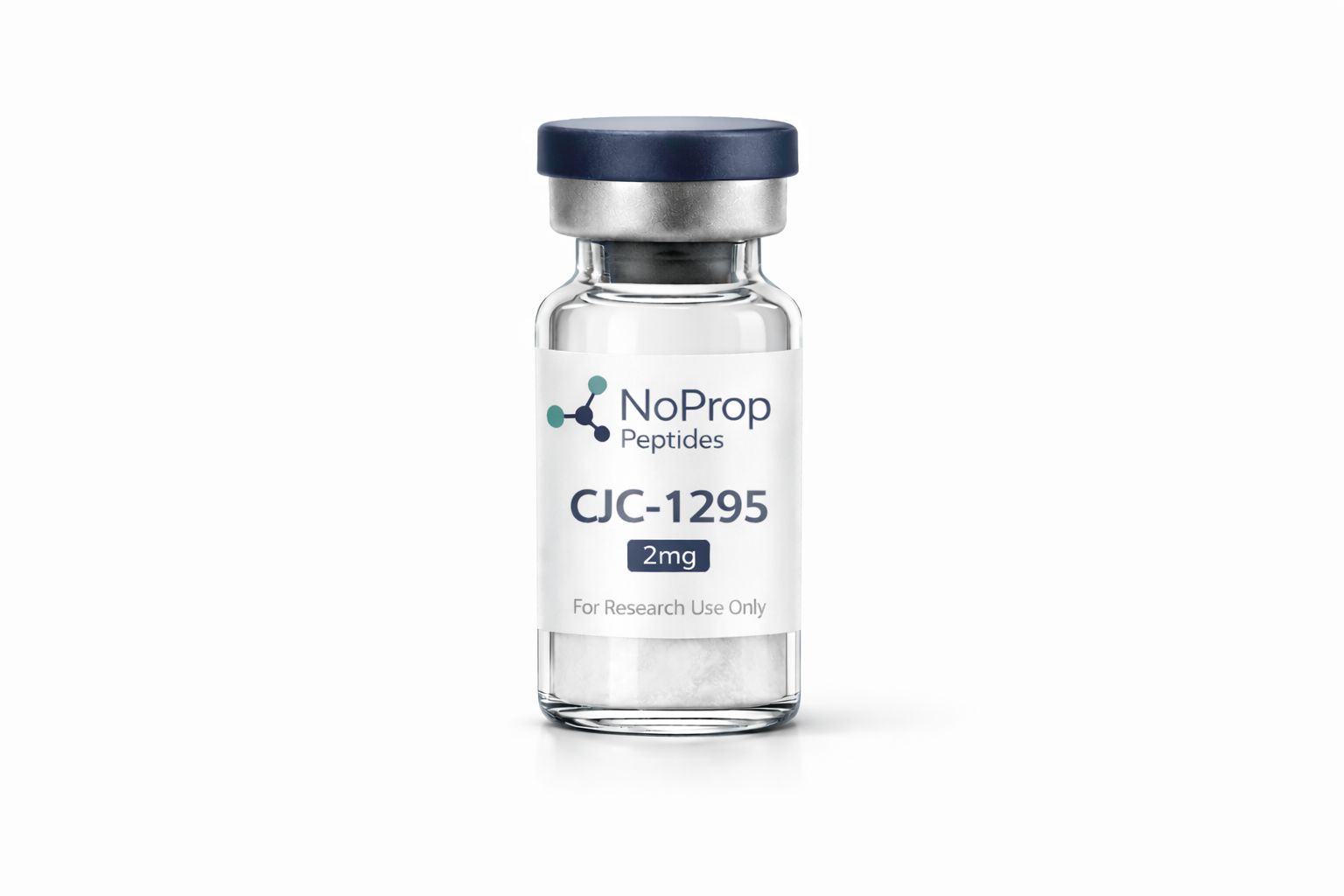
CJC-1295
$44.99
Research-grade CJC-1295 (with and without DAC). 99%+ purity, third-party tested. 5mg per vial.
Description
CJC-1295 is a synthetic analog of growth hormone releasing hormone (GHRH) — a 44-amino acid peptide modified with specific amino acid substitutions to resist enzymatic degradation. The result is a compound with a biological half-life measured in days rather than the minutes typical of native GHRH.
Research Profile
Two variants exist in research: CJC-1295 with DAC (Drug Affinity Complex) and CJC-1295 without DAC (also called Modified GRF 1-29). The DAC version binds to serum albumin, extending plasma half-life to approximately 8 days. The non-DAC version produces sharper, more defined GH pulses with a half-life of approximately 30 minutes. Both variants stimulate the pituitary via the GHRH receptor, producing dose-dependent increases in growth hormone and IGF-1 levels.
Key Research Areas
- Sustained growth hormone elevation without desensitization
- IGF-1 level modulation
- Lean body composition changes in research models
- Sleep architecture and deep sleep enhancement
- Synergistic effects when combined with GHRP-class peptides
Specifications
| Type | GHRH analog (Modified GRF 1-29) |
| Molecular Weight | 3367.97 g/mol (without DAC) |
| Purity | ≥99% (HPLC verified) |
| Form | Lyophilized powder |
| Quantity | 5mg per vial |
| Storage | -20°C pre-reconstitution / 2-8°C post-reconstitution |
Related Research Peptides
CJC-1295 is most commonly researched in combination with Ipamorelin — the two target complementary pathways (GHRH + ghrelin receptor). We also carry the pre-blended CJC-1295/Ipamorelin combination. For the full growth hormone peptide landscape, see our muscle growth peptides guide.
Research Dosage Protocols
CJC-1295 research protocols differ substantially depending on whether the DAC (Drug Affinity Complex) form or the no-DAC form is used. CJC-1295 with DAC is typically dosed once or twice weekly due to its extended half-life of 6–8 days, with animal studies using 1–3mg/kg subcutaneously. The no-DAC form (also sold as Mod GRF 1-29) has a much shorter window and is administered immediately before or after relevant stimuli in pulsatile GH research. A 2mg vial reconstituted in 1mL bacteriostatic water gives 2,000mcg/mL. Typical research protocols run 8–12 weeks to assess GH axis responses.
Frequently Asked Questions
DAC vs. no-DAC: which form is appropriate for different research designs?
CJC-1295 with DAC forms a covalent bond with serum albumin, extending its half-life to 6–8 days. This creates sustained, continuous GHRH receptor stimulation — useful for research requiring stable elevated GH levels without frequent administration. The no-DAC form (Mod GRF 1-29) is active for 30–45 minutes, producing a discrete pulse of GH release more consistent with natural pulsatile physiology. Researchers studying chronic GH elevation effects choose DAC; those studying pulsatile GH secretion dynamics, or pairing with GHRPs for synergistic release, use no-DAC. The two are not interchangeable — they produce fundamentally different GH secretion patterns.
What is the actual half-life difference between the two forms?
CJC-1295 without DAC (Mod GRF 1-29) has a half-life of approximately 30 minutes in circulation, versus native GHRH which is destroyed within 2–5 minutes by dipeptidyl peptidase IV (DPP-IV). The structural modifications in Mod GRF 1-29 (substitutions at positions 2, 8, 15, and 27) confer DPP-IV resistance, extending the window without DAC technology. CJC-1295 with DAC further extends this to 6–8 days through albumin binding. This creates three distinct half-life tiers: native GHRH (minutes), Mod GRF 1-29 (30–45 min), and CJC-1295 with DAC (days) — each relevant to different research questions.
When should CJC-1295 be administered relative to other research events?
For no-DAC CJC-1295 research, timing matters because the peptide’s window aligns with natural GH release patterns. Administration during fasting states (or early sleep phases in nocturnal studies) produces stronger GH pulse responses because somatostatin tone is lower. In protocols combining CJC-1295 (no-DAC) with a GHRP, simultaneous administration is standard — the GHRH analog and GHRP act on different but synergistic receptors. CJC-1295 with DAC doesn’t require timing precision due to its extended half-life — once or twice weekly administration creates sustained background GHRH signaling.
Can CJC-1295 be combined with Ipamorelin in research protocols?
Yes — the CJC-1295/Ipamorelin combination is one of the most studied pairings in GH secretagogue research. CJC-1295 acts on GHRH receptors in the pituitary to prime somatotroph cells. Ipamorelin acts on GHSR-1a (ghrelin receptor) to trigger GH release. These two receptor pathways are distinct and additive — stimulating both simultaneously produces greater GH pulse amplitude than either peptide alone. Published research confirms the synergy is roughly 2–3x the GH release of either compound used individually. The combination also maintains more physiologically pulsatile secretion than either continuous GHRH agonism alone.
Does CJC-1295 with DAC cause receptor desensitization?
Continuous GHRH receptor stimulation from CJC-1295 DAC’s week-long half-life raises legitimate questions about GHRH receptor downregulation. Some research models show attenuated GH responses with prolonged continuous GHRH agonism — the pituitary’s somatotroph cells can reduce receptor expression in response to sustained ligand occupancy. This is one reason some researchers prefer the no-DAC form, which mimics pulsatile GHRH rather than constant stimulation. Studies specifically designed around CJC-1295 DAC dosing frequency suggest once-weekly administration may reduce desensitization risk compared to more frequent dosing.
How do I reconstitute CJC-1295, and how long does it last after reconstitution?
A standard 2mg vial reconstitutes with 1mL bacteriostatic water for a 2,000mcg/mL concentration. CJC-1295 dissolves readily with gentle rolling. Refrigerated at 2–8°C in bacteriostatic water, potency is maintained for approximately 4–6 weeks. The DAC and no-DAC forms have similar reconstituted stability — both require refrigerated storage and avoidance of light exposure. For longer-term storage beyond a single use window, lyophilized powder at -20°C is preferred, with reconstitution done in smaller batches to avoid repeated temperature cycling of a single vial.
For research and laboratory use only. Not for human consumption. All peptides are sold strictly as research chemicals.