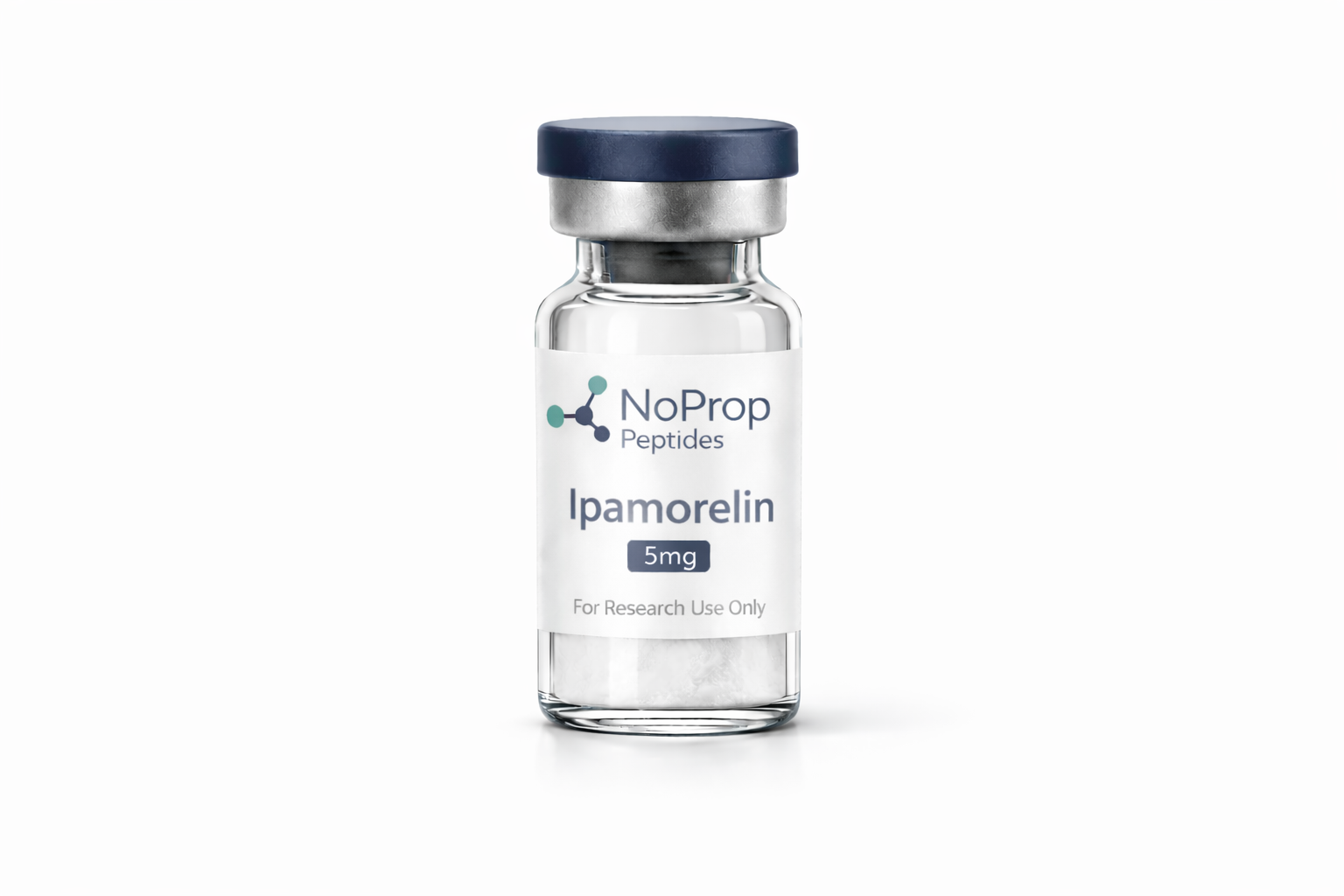
Ipamorelin
$39.99
Research-grade Ipamorelin peptide. 99%+ purity, third-party tested. 5mg per vial.
Description
Ipamorelin is a pentapeptide growth hormone secretagogue that binds selectively to the ghrelin/GHS receptor. Developed in the late 1990s, it earned a reputation among researchers for producing consistent GH release with a remarkably clean side-effect profile — no significant cortisol, prolactin, or appetite stimulation at standard research doses, unlike earlier secretagogues like GHRP-6.
Research Profile
Ipamorelin triggers growth hormone release by mimicking ghrelin at the pituitary level. What makes it distinct: it produces a pulse that closely mirrors the body’s natural GH secretion pattern. Studies in the European Journal of Endocrinology documented sustained GH elevation without receptor desensitization — a limitation that plagues many other secretagogues over extended research timelines.
Key Research Areas
- Selective GH release without cortisol or prolactin elevation
- Bone mineral content and density research
- Body composition changes (lean mass, fat metabolism)
- Gut motility and post-operative recovery models
- Synergistic GH amplification when paired with GHRH analogs
Specifications
| Sequence | Aib-His-D-2-Nal-D-Phe-Lys-NH₂ |
| Molecular Weight | 711.85 g/mol |
| Purity | ≥99% (HPLC verified) |
| Form | Lyophilized powder |
| Quantity | 5mg per vial |
| Storage | -20°C pre-reconstitution / 2-8°C post-reconstitution |
Related Research Peptides
The CJC-1295 + Ipamorelin combination is the most widely studied GH peptide stack — we carry it as a pre-blended option. Compare all growth hormone peptides in our muscle growth guide.
Research Dosage Protocols
Ipamorelin is typically studied at doses ranging from 200–600mcg per administration in animal and in vitro GH research contexts. Because it has a short half-life (~2 hours), pulsatile administration is standard — multiple daily doses in rodent studies to replicate the research period of interest. A common reconstitution for a 5mg vial uses 2mL bacteriostatic water to yield 2,500mcg/mL, allowing flexible dosing with standard insulin syringes. Research protocols assessing GH pulse dynamics often time administration to coincide with the dark cycle in nocturnal animal models when endogenous GH release is highest.
Frequently Asked Questions
Why is Ipamorelin described as “selective” compared to other GHRPs?
Ipamorelin’s selectivity refers to its specificity for the growth hormone secretagogue receptor (GHSR-1a) without significant binding at other receptors that GHRP-2 and GHRP-6 also activate. Specifically, Ipamorelin does not meaningfully stimulate ACTH/cortisol release or prolactin secretion at research doses, while GHRP-2 and GHRP-6 do. This makes Ipamorelin a cleaner research tool when the study question is specifically about GH axis effects — the researcher gets GH pulse data without cortisol confounds. The selectivity was characterized in Novo Nordisk’s original preclinical work in the late 1990s.
How does Ipamorelin compare to GHRP-6 on cortisol and prolactin?
GHRP-6 stimulates cortisol and prolactin release in addition to GH, which is attributed to its binding at non-GHSR receptors and its more potent ghrelin-mimetic activity. In direct comparison studies, Ipamorelin at equivalent GH-stimulating doses produces minimal elevation in cortisol or prolactin, while GHRP-6 produces measurable increases in both. For researchers specifically studying GH secretion dynamics — rather than broad pituitary output — Ipamorelin’s cleaner profile produces less confounded data. GHRP-6’s cortisol and appetite effects, however, are research-relevant in their own right for metabolic studies.
Does timing around sleep phases affect Ipamorelin research results?
Yes — endogenous GH release is pulsatile and tied to sleep architecture, with the largest pulse occurring in early slow-wave sleep. Ipamorelin, as a GHRP, amplifies existing GH pulses rather than creating entirely new ones. Administration during periods of low somatostatin tone (which includes early sleep onset) produces larger GH responses. In rodent research using nocturnal models, administration at the start of the dark cycle aligns with the animal’s active/sleep equivalent. Researchers measuring GH pulse amplitude should control for administration timing relative to circadian phase to ensure reproducible results across experimental groups.
Does Ipamorelin lose effectiveness over extended research periods?
GHSR-1a has documented desensitization properties — like most G-protein coupled receptors, prolonged agonism can trigger receptor internalization and reduced response. Some GHRPs show tachyphylaxis at high doses or very frequent administration. Ipamorelin’s published research suggests it maintains efficacy better than GHRP-2 with extended use, possibly because of its lower receptor-binding efficacy (it’s a partial agonist at GHSR-1a). Standard research protocols use cycling strategies — typically 8–12 weeks on with breaks — both to study time-course effects and to evaluate whether receptor sensitivity is maintained.
Can Ipamorelin be used as a standalone peptide in GH research, without a GHRH analog?
Yes — Ipamorelin produces meaningful GH release as a standalone compound. Its mechanism (GHSR-1a agonism → pituitary somatotroph activation) does not require GHRH to be co-administered. Published studies using Ipamorelin alone show significant GH elevation. That said, combining Ipamorelin with a GHRH analog like CJC-1295 or Sermorelin produces synergistic GH release that’s 2–3x greater than either compound alone, because the two receptor pathways converge on different aspects of somatotroph activation. Standalone Ipamorelin is appropriate when the research design requires isolating GHSR-1a-mediated effects specifically.
How does Ipamorelin differ from GHRP-2?
GHRP-2 is a more potent GH releaser than Ipamorelin on a per-microgram basis, but produces larger cortisol, prolactin, and ACTH elevations. GHRP-2 also has stronger appetite-stimulating effects because of its ghrelin receptor activity. Ipamorelin sacrifices some GH-stimulating potency in exchange for selectivity — less off-target receptor activity means cleaner data when GH is the variable being studied. In research where appetite or metabolic effects are the subject, GHRP-2 may actually be the preferred tool. The choice between them should be dictated by what the study is measuring, not by a blanket judgment of which is “better.”
For research and laboratory use only. Not for human consumption. All peptides are sold strictly as research chemicals.