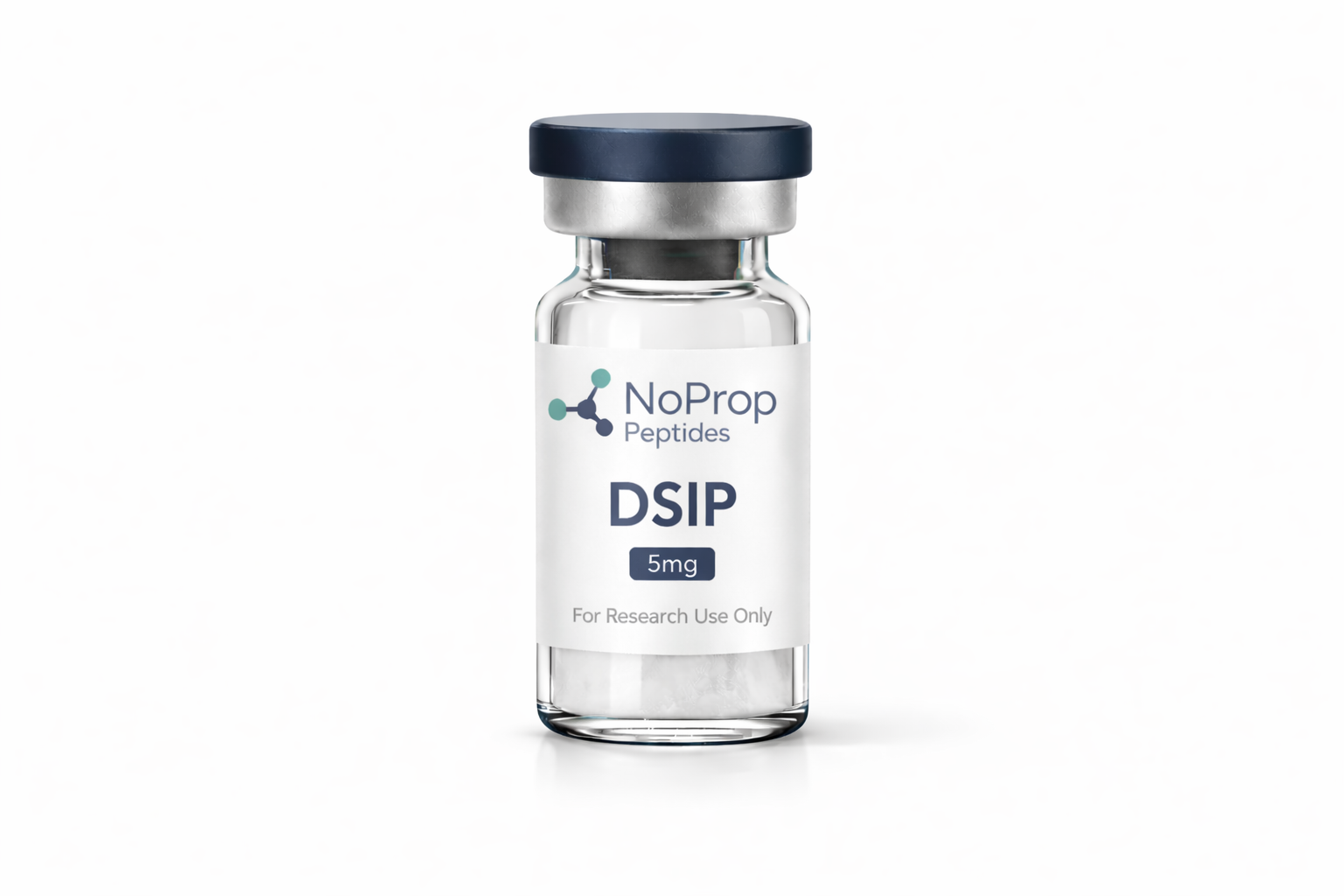
DSIP
$49.00
Research-grade DSIP (Delta Sleep-Inducing Peptide). 99%+ purity, third-party tested. 5mg per vial.
Description
DSIP (Delta Sleep-Inducing Peptide) is a nine-amino acid neuropeptide first isolated in 1977 from the cerebral venous blood of rabbits during induced sleep. Named for its ability to promote delta wave sleep patterns in EEG studies, DSIP has since been found to influence a far broader range of physiological processes than its name suggests.
Research Profile
DSIP crosses the blood-brain barrier and acts on multiple neuroendocrine targets. Research documents its modulation of corticotropin and cortisol levels, influence on LH and GH secretion patterns, and effects on pain perception thresholds. Sleep studies show promotion of slow-wave (delta) sleep without suppressing REM — a profile distinct from sedative compounds that typically disrupt sleep architecture rather than enhance it.
Key Research Areas
- Delta wave sleep promotion without REM suppression
- Cortisol and stress hormone modulation
- Pain perception threshold elevation
- LH and growth hormone secretion patterns
- Oxidative stress protection
Specifications
| Sequence | Trp-Ala-Gly-Gly-Asp-Ala-Ser-Gly-Glu |
| Molecular Weight | 848.81 g/mol |
| Purity | ≥99% (HPLC verified) |
| Form | Lyophilized powder |
| Quantity | 5mg per vial |
| Storage | -20°C pre-reconstitution / protect from light |
Related Research Peptides
DSIP addresses the recovery side of cognitive optimization. Pair with Selank (anxiolytic) and Semax (cognitive enhancement) for comprehensive nootropic research. See our nootropic peptides guide.
Research Dosage Protocols
DSIP (Delta Sleep-Inducing Peptide) was originally isolated in 1977 from rabbit cerebral venous blood during natural sleep, and has since been studied in sleep, stress, and neuroendocrine contexts. Published animal sleep research uses intravenous and subcutaneous doses of 0.25–1mg/kg administered in the pre-sleep phase. A 5mg vial reconstituted in 2mL bacteriostatic water yields 2,500mcg/mL. DSIP research protocols focus heavily on timing — administration 1–2 hours before expected sleep onset captures the relevant measurement window. Studies examining HPA axis and cortisol modulation have used morning administration to assess daytime effects on stress hormones.
Frequently Asked Questions
What exactly is “delta sleep,” and how does DSIP relate to it?
Delta sleep refers to slow-wave sleep (SWS) — sleep stages 3 and 4 characterized by high-amplitude, low-frequency delta brain waves (0.5–4 Hz) on EEG. This is the deepest stage of non-REM sleep and the period when most physical restoration and growth hormone secretion occurs. DSIP was named after its discovery in studies where rabbit brain venous blood collected during natural sleep induced more delta wave activity when infused into other rabbits. Published research shows DSIP increases the proportion of time spent in slow-wave sleep and reduces sleep onset latency. REM sleep (rapid eye movement, the dream stage) is a separate sleep architecture component — DSIP’s primary documented effect is on delta/SWS, not REM.
Does DSIP cause grogginess or next-day sedation?
Research models do not document significant residual sedation from DSIP. Unlike benzodiazepines, which extend total sleep time partly through sedative mechanisms that persist into waking hours, DSIP’s mechanism appears to work through physiological sleep architecture enhancement rather than pharmacological CNS depression. Studies in both rodent and limited human research show improved sleep quality metrics without next-day cognitive impairment. The absence of morning grogginess is consistent with DSIP acting to increase natural SWS rather than artificially suppressing arousal systems the way sedative-hypnotics do. This profile makes DSIP relevant to research on sleep quality enhancement without sedative confounds.
How does DSIP’s cortisol modulation mechanism work?
DSIP modulates the hypothalamic-pituitary-adrenal (HPA) axis through central neuropeptide signaling that reduces CRH (corticotropin-releasing hormone) activity. Elevated CRH drives cortisol production and also disrupts sleep architecture — high cortisol at night is associated with reduced SWS. DSIP’s ability to dampen excess HPA activation creates a permissive environment for deeper sleep by reducing the arousal signal that CRH generates. Published research in chronic stress models shows DSIP normalizes elevated corticosterone levels. This makes DSIP interesting for stress-related sleep disruption research, where the sleep problem and cortisol dysregulation are intertwined rather than independent phenomena.
What is the optimal timing for DSIP administration in research?
Timing is critical because DSIP’s sleep-promoting effects are linked to the circadian window when sleep architecture is naturally established. Animal studies consistently administer DSIP 1–2 hours before the expected sleep onset period. In human clinical studies (limited), evening administration before bedtime was the standard. For rodent research in nocturnal species, this means administration near the end of the active (dark) phase. Morning administration in studies measuring HPA/cortisol effects captures neuroendocrine responses in the early active phase. DSIP’s effects are state-dependent — the peptide doesn’t force sleep against circadian timing but rather enhances the depth of sleep during the natural sleep window.
How do I reconstitute DSIP, and how long does it remain stable?
DSIP is a nonapeptide (9 amino acids: Trp-Ala-Gly-Gly-Asp-Ala-Ser-Gly-Glu) that reconstitutes easily in bacteriostatic water. Add 2mL to a 5mg vial for 2,500mcg/mL. It dissolves within a few minutes with gentle rolling. Refrigerate at 2–8°C; working stability approximately 4–6 weeks. Lyophilized powder at -20°C is stable for 12–24 months. DSIP contains a tryptophan residue which is susceptible to photo-oxidation — protect reconstituted solutions from light exposure with amber vials or foil wrapping. This is more critical for DSIP than for peptides without aromatic residues in the sequence.
Can DSIP be combined with other nootropic peptides in research?
DSIP is sometimes studied alongside Selank (anxiolytic) or Epithalon (circadian/melatonin research) because these peptides address adjacent aspects of sleep and stress biology. The combination rationale: DSIP targets slow-wave sleep depth; Selank addresses anxiety-related sleep disruption; Epithalon addresses circadian melatonin patterns. There are no published combination studies with defined endpoints for these three together — most available data is from single-compound protocols. Researchers combining them in multi-peptide studies should be aware that overlapping HPA axis modulation between DSIP and Selank may make cortisol as an outcome variable more difficult to attribute to a single compound.
Does DSIP show tolerance development with repeated administration?
Published literature does not document significant tolerance to DSIP’s sleep-promoting effects. This distinguishes it from sedative-hypnotics that show rapid tolerance through receptor downregulation (benzodiazepines) or tolerance within 2 weeks (z-drugs like zolpidem). DSIP’s mechanism doesn’t rely on receptor occupancy at a single sedative receptor — it influences endogenous sleep regulatory peptide systems and the HPA axis rather than directly suppressing arousal. The limited human trial data (primarily from the 1980s European clinical research period) doesn’t report dose escalation requirements over time, consistent with an endogenous peptide that works within natural regulatory systems rather than against them.
For research and laboratory use only. Not for human consumption. All peptides are sold strictly as research chemicals.