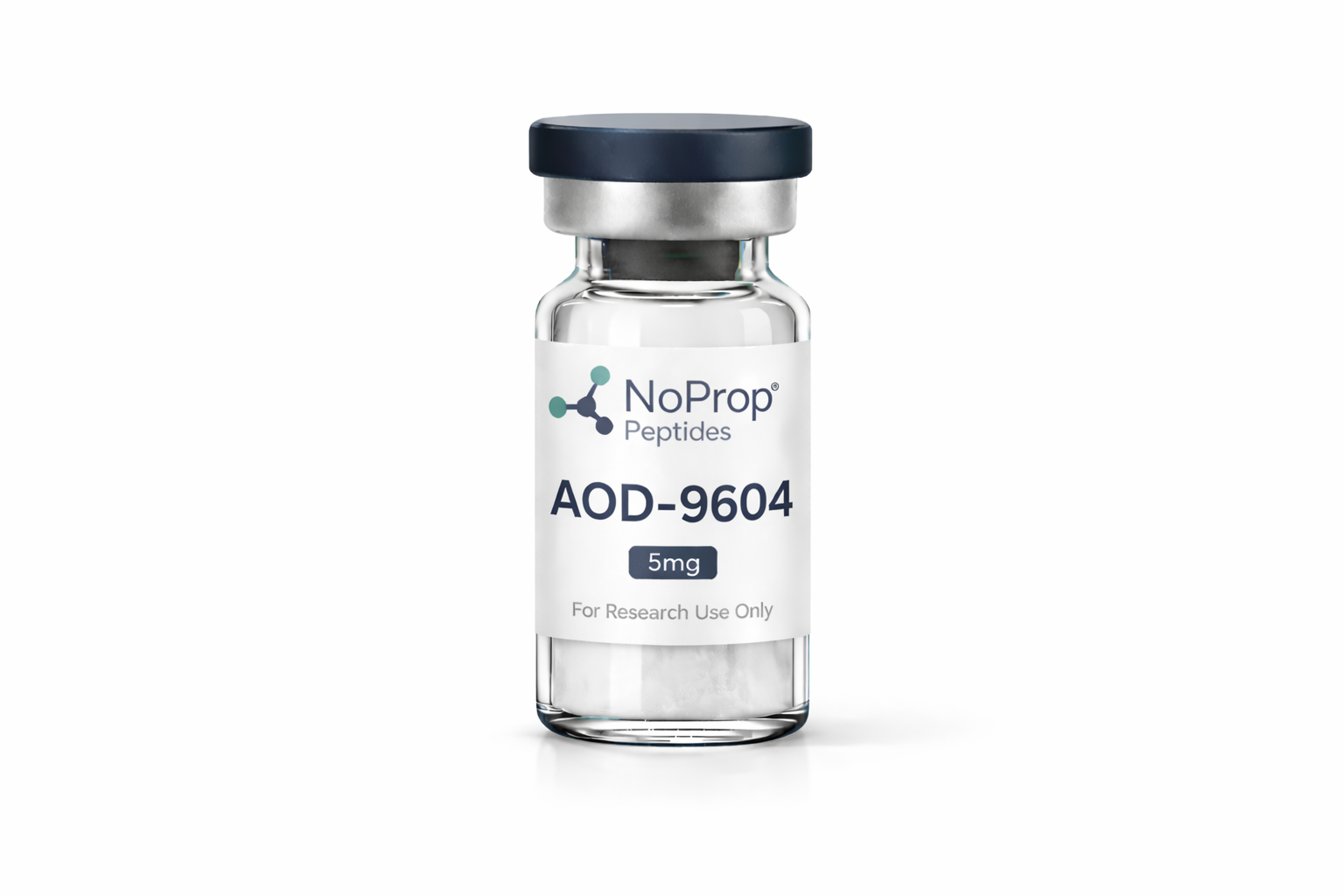
AOD-9604
$44.99
Research-grade AOD-9604 (GH fragment 176-191). 99%+ purity, third-party tested. 5mg per vial.
Description
AOD-9604 is a modified 16-amino acid fragment of human growth hormone, corresponding to the C-terminal region (amino acids 176-191) with a tyrosine substitution at position 177. Developed by Metabolic Pharmaceuticals in Australia, AOD-9604 retains the lipolytic activity of the full GH molecule while eliminating growth-promoting and diabetogenic effects — a selectivity that made it the subject of extensive clinical development through Phase II trials.
Research Profile
AOD-9604 stimulates lipolysis (fat breakdown) and inhibits lipogenesis (fat formation) through a mechanism independent of the GH receptor. Research published in the Journal of Endocrinology demonstrated that the fragment doesn’t compete for GH receptor binding — meaning it doesn’t affect IGF-1 levels, blood glucose, or insulin sensitivity at research doses. This separation of lipolytic from growth-promoting activity is the compound’s defining characteristic. Notably, AOD-9604 also received GRAS (Generally Recognized as Safe) status from the FDA for use as a food ingredient.
Key Research Areas
- Lipolysis stimulation without GH receptor activation
- Lipogenesis inhibition in adipocyte models
- Cartilage repair and regeneration (newer research area)
- Osteoarthritis and joint tissue models
- Metabolic profile without IGF-1 or glucose effects
Specifications
| Type | Modified GH fragment (176-191) |
| Molecular Weight | 1817.12 g/mol |
| Purity | ≥99% (HPLC verified) |
| Form | Lyophilized powder |
| Quantity | 5mg per vial |
| Storage | -20°C pre-reconstitution |
Related Research Peptides
For full-spectrum GH axis research, see CJC-1295 and Ipamorelin (GH secretagogues) or IGF-1 LR3 (downstream GH effector). Browse our complete peptide catalog.
Research Dosage Protocols
AOD-9604 (Advanced Obesity Drug) is the hGH fragment (176-191) modified with a tyrosine residue at the N-terminus for stability. Research doses in published lipolysis and metabolic studies range from 250–500mcg subcutaneously per administration. Animal obesity research used 0.5–1mg/kg daily. A 5mg vial reconstituted in 2mL bacteriostatic water yields 2,500mcg/mL. AOD-9604 has undergone Phase 1–3 human clinical trials (Monash University/Metabolic Pharmaceuticals) which provide human PK and safety data at doses of 1–54mg — an unusually wide tested range. For cartilage and articular research (a newer application area), protocols are still being established from preclinical data.
Frequently Asked Questions
What does GRAS status mean for AOD-9604?
GRAS stands for “Generally Recognized As Safe” — a designation from the US FDA for substances that qualified experts consider safe based on scientific evidence and history of use. AOD-9604 received GRAS status from the FDA in 2014, specifically for use as a food ingredient. This doesn’t mean FDA approval as a drug — it’s a different regulatory pathway applying to food additives and supplements. GRAS status is notable for a synthetic peptide because it reflects the favorable safety profile established through extensive human clinical trials (Phase 1–3) conducted by Metabolic Pharmaceuticals, including long-term administration studies. No serious safety signals emerged in trials across over 900 human subjects.
Why doesn’t AOD-9604 affect IGF-1 levels or blood glucose?
Native growth hormone has multiple binding domains that interact with different receptors and downstream signaling cascades. The N-terminal region of GH drives IGF-1 production in the liver and influences glucose metabolism through insulin signaling interactions. AOD-9604 is the C-terminal fragment (residues 176–191) of the GH molecule — the region responsible for lipolytic activity specifically. This fragment does not activate the GH receptor domains that drive hepatic IGF-1 synthesis. Clinical trials confirmed no measurable effect on serum IGF-1 or fasting glucose. This selectivity makes AOD-9604 a cleaner research tool for fat metabolism studies — researchers can study lipolytic mechanisms without the growth and glucose confounds that come with full GH administration.
What is the origin of the GH fragment designation?
The human growth hormone protein contains 191 amino acids. Early research by Professor Frank Ng at Monash University identified that the C-terminal region (amino acids 176–191) was responsible for GH’s fat-burning activity — specifically its ability to activate beta-3 adrenergic receptors on adipocytes and regulate lipid mobilization. AOD-9604 is this 16-amino acid fragment with a tyrosine added at position 176 for stability (without it, the fragment degraded too rapidly to study). The “176-191” designation in research literature refers to the position numbers within the full hGH sequence. “AOD” stood for “Advanced Obesity Drug” — the intended clinical application before the program was discontinued at Phase 3.
What does cartilage research with AOD-9604 involve?
The cartilage research application emerged after the obesity drug development program ended. Preclinical studies identified that AOD-9604 stimulates chondrogenesis (cartilage cell formation) and proteoglycan synthesis in cartilage tissue — effects that are distinct from its lipolytic mechanism. In vitro studies using human chondrocytes showed dose-dependent increases in type II collagen and aggrecan production. In vivo studies in rodent osteoarthritis models showed histological improvement in cartilage degradation scores. This application is newer and has a thinner evidence base than the metabolic/obesity research, but it’s motivated by the clinical need for non-surgical cartilage repair approaches and AOD-9604’s established safety profile from the prior obesity trials.
Has oral bioavailability of AOD-9604 been studied?
Yes — oral delivery was specifically studied as part of the obesity drug development program because an injectable obesity drug faces major adoption barriers versus a pill. Published data shows AOD-9604 has some oral bioavailability (estimated 3–10% in animal models), which is unusual for a 16-amino acid peptide — most peptides of this size are destroyed by GI peptidases. The relative stability may relate to its disulfide-containing cyclic region at the C-terminus. Metabolic Pharmaceuticals investigated oral formulations, but the Phase 3 clinical trial (using injectable) was discontinued for efficacy reasons before oral delivery fully replaced injection as the primary delivery route in their program.
How does AOD-9604 compare to full growth hormone in lipolysis research?
AOD-9604 and full GH both produce lipolytic effects, but through partially overlapping mechanisms. Full GH uses multiple pathways including IGF-1-mediated and direct beta-3 adrenergic receptor stimulation on adipocytes. AOD-9604 drives lipolysis primarily via the beta-3 adrenergic receptor pathway (the same mechanism used by the GH fragment region specifically) without the IGF-1 amplification that full GH triggers. In comparative research, AOD-9604 at equivalent lipolytic doses doesn’t produce the anabolic, growth-promoting, or diabetogenic effects of full GH. For researchers specifically studying adipocyte biology and fat mobilization pathways without GH’s systemic anabolic and glucose effects, AOD-9604 is the appropriate selective tool.
For research and laboratory use only. Not for human consumption. All peptides are sold strictly as research chemicals.