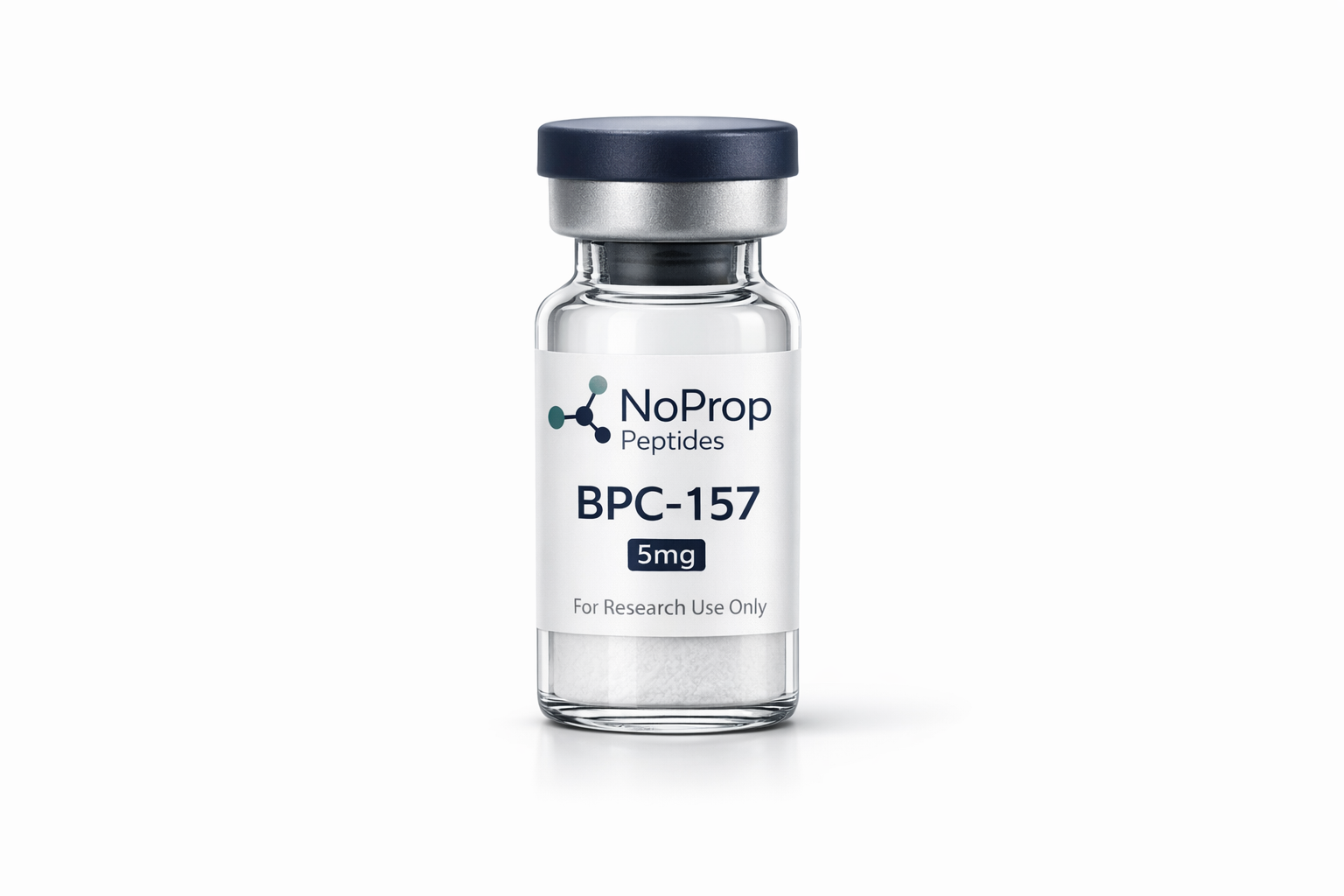
BPC-157
$59.00
Research-grade BPC-157 peptide. 99%+ purity, third-party tested via HPLC and mass spectrometry. 5mg per vial.
Description
BPC-157 (Body Protection Compound-157) is a 15-amino acid partial sequence of body protection compound found in human gastric juice. First isolated in 1993, it has since become one of the most extensively studied peptides in regenerative research.
Research Profile
Published studies document BPC-157’s interaction with multiple biological pathways. Researchers have observed its influence on nitric oxide signaling, growth factor modulation (including VEGF, EGF, and FGF), and the FAK-paxillin pathway involved in tissue remodeling. Over 100 peer-reviewed studies have been published since its discovery — a volume of research uncommon for most synthetic peptides.
Key Research Areas
- Tendon and ligament repair mechanisms
- Gastrointestinal mucosal protection
- Muscle tissue recovery following injury
- Neuroprotective effects and peripheral nerve regeneration
- Bone healing and density preservation
Specifications
| Sequence | Gly-Glu-Pro-Pro-Pro-Gly-Lys-Pro-Ala-Asp-Asp-Ala-Gly-Leu-Val |
| Molecular Weight | 1419.53 g/mol |
| Purity | ≥99% (HPLC verified) |
| Form | Lyophilized powder |
| Quantity | 5mg per vial |
| Storage | -20°C pre-reconstitution / 2-8°C post-reconstitution |
Third-Party Testing
Every batch ships with a Certificate of Analysis from an independent laboratory. Testing includes HPLC purity analysis and electrospray ionization mass spectrometry (ESI-MS) for molecular weight verification. We publish COAs because researchers shouldn’t have to guess what’s in the vial.
Handling & Reconstitution
BPC-157 arrives as a lyophilized (freeze-dried) powder. Reconstitute with bacteriostatic water for research applications. See our peptide reconstitution guide for step-by-step instructions and our dosage reference for protocol information.
Related Research Peptides
Researchers studying tissue repair often investigate BPC-157 alongside TB-500 (Thymosin Beta-4) for complementary mechanisms, and GHK-Cu for collagen synthesis pathways. For a full comparison, see our guide to the best peptides for healing and recovery.
Research Dosage Protocols
In published animal studies, BPC-157 has been administered at 10mcg/kg subcutaneously and intraperitoneally, with researchers noting dose-dependent effects on tendon and mucosal tissue. A common reconstitution for a 5mg vial uses 2mL bacteriostatic water to yield a 2.5mcg/µL concentration, allowing precise volume-based dosing. Research protocols typically run 4–12 weeks with no established tolerance pattern. Oral administration has been studied in GI models using the same reconstituted solution delivered via gavage.
Frequently Asked Questions
Is BPC-157 stable in solution, and how long does it last after reconstitution?
Reconstituted BPC-157 in bacteriostatic water remains stable for approximately 4–6 weeks when stored at 2–8°C in a sealed vial protected from light. Degradation accelerates above room temperature. Research labs typically prepare only the volume needed for a 30-day window to ensure peptide integrity. Freeze-thaw cycling should be avoided — repeated temperature fluctuations cleave the peptide chain and reduce potency. Some studies use acetic acid as a carrier instead, which shortens working stability to around 2 weeks.
What’s the difference between subcutaneous and oral administration in research?
Subcutaneous delivery bypasses first-pass hepatic metabolism, giving more predictable systemic distribution. Oral and intragastric administration has been studied extensively in GI mucosal models — BPC-157 shows unusual stability in gastric acid relative to most peptides, which makes oral delivery viable for gut-specific research applications. Systemic effects from oral dosing appear weaker, but local GI tissue effects are well-documented at similar concentrations. Most musculoskeletal and neurological research uses subcutaneous or intraperitoneal delivery.
How do I reconstitute a 5mg vial for research use?
Add 2mL of bacteriostatic water to 5mg of lyophilized BPC-157 for a working concentration of 2,500mcg/mL (2.5mcg/µL). Roll the vial gently — never shake, as mechanical agitation can denature the peptide. Allow 5–10 minutes for full dissolution. At this concentration, typical research volumes in the 250–500mcg range require 0.1–0.2mL, which is easy to measure with a standard insulin syringe. Label the vial with the reconstitution date and store refrigerated.
What’s the difference between BPC-157 and BPC-157 Stable (arginine salt form)?
Standard BPC-157 is the free-acid form. BPC-157 Stable — also called BPC-157 Arginate — is the same 15-amino acid sequence complexed with arginine to improve aqueous stability. The arginine salt form is more resistant to degradation in solution and at room temperature, making it relevant for oral delivery research where the compound must survive transit through the GI environment. Potency on a molar basis is comparable, but researchers need to account for the added molecular weight of arginine when calculating concentrations.
Can BPC-157 be stacked with TB-500 in research protocols?
Yes — the BPC-157/TB-500 combination is one of the most studied peptide pairings in tissue repair research. BPC-157 primarily drives angiogenesis and connective tissue remodeling through VEGF and FAK-paxillin signaling, while TB-500 (a Thymosin Beta-4 fragment) promotes actin polymerization and cell migration. Their mechanisms are complementary rather than redundant. Some researchers administer them in separate syringes at the same session to avoid any interaction in solution, as the stability of mixed peptide solutions is not well-characterized.
What does purity percentage actually mean for research outcomes?
Purity expressed as a percentage reflects the fraction of the sample that is the target peptide, measured by HPLC area-under-curve. At 98% purity, 2% of the vial weight is related peptide fragments, synthesis byproducts, or residual solvents. For most research applications, ≥98% is considered research-grade. Below 95%, impurity profiles become significant enough to confound results — a researcher may attribute an observed effect to BPC-157 when it’s partially driven by an unknown fragment. This is why COA documentation with HPLC chromatograms matters.
Does BPC-157 cause receptor desensitization with prolonged use in research models?
Current published literature does not document classic receptor downregulation with BPC-157. Unlike peptides that act on specific GPCRs — where prolonged agonism can trigger internalization — BPC-157 modulates downstream signaling cascades (nitric oxide synthase, VEGF pathway) rather than acting as a direct receptor agonist in the traditional sense. Animal studies running 4–12 weeks have not shown diminished response over time. That said, long-term tolerance studies in primates or humans don’t exist, so definitive conclusions require more research.
What research areas beyond tendon repair have shown the most consistent results?
Gastrointestinal mucosal healing has arguably the deepest literature — BPC-157 was first characterized in gastric juice, and studies show consistent protection against NSAID-induced ulcers, inflammatory bowel models, and intestinal anastomosis healing in rodents. Neurological research is the fastest-growing area, with studies examining peripheral nerve regeneration, traumatic brain injury models, and dopamine system modulation (making it relevant to Parkinson’s model research). Bone fracture healing and ischemia-reperfusion injury models also have published data worth reviewing.
For research and laboratory use only. Not for human consumption. All peptides are sold strictly as research chemicals.