CJC-1295 / Ipamorelin Blend
$78.00
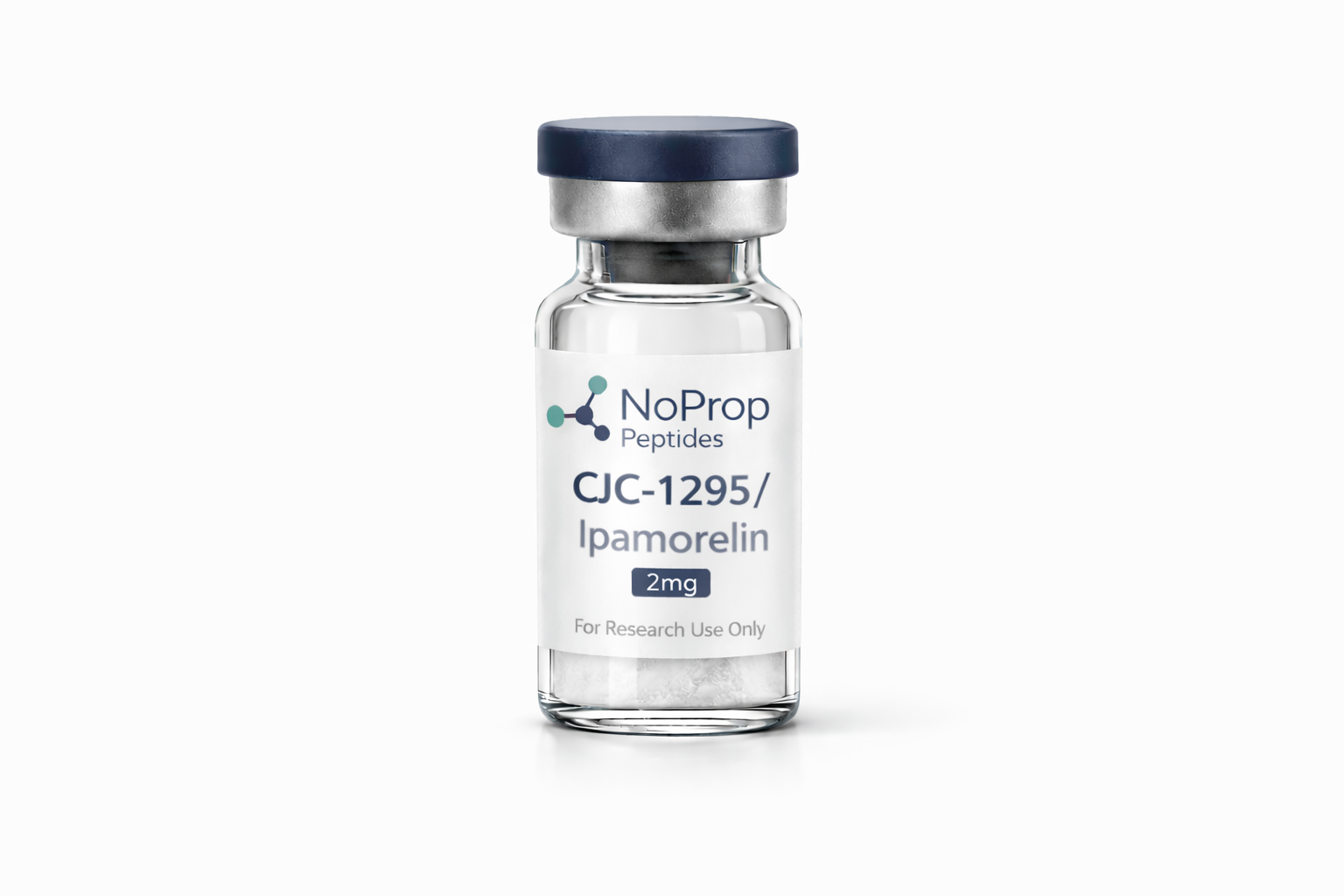
Pre-blended CJC-1295/Ipamorelin combination. 99%+ purity, third-party tested. 10mg per vial (5mg/5mg).
Description
This pre-blended formulation combines CJC-1295 (Modified GRF 1-29) and Ipamorelin in a single vial — the most commonly researched growth hormone peptide combination in the literature. The blend eliminates reconstitution math and ensures precise ratios for consistent research protocols.
Why This Combination
CJC-1295 and Ipamorelin target two different receptors that converge on the same outcome. CJC-1295 stimulates the GHRH receptor — telling the pituitary to produce growth hormone. Ipamorelin stimulates the ghrelin receptor — telling the pituitary to release it. The dual-pathway activation produces GH output greater than either peptide alone, documented across multiple studies as a synergistic (not merely additive) effect.
Key Research Areas
- Amplified GH pulse amplitude vs. single-peptide protocols
- Extended IGF-1 elevation windows
- Body composition research (lean mass, fat metabolism)
- Sleep quality and deep sleep architecture
- Recovery and repair marker improvement
Specifications
| Contents | CJC-1295 (no DAC) 5mg + Ipamorelin 5mg |
| Total Quantity | 10mg per vial |
| Purity | ≥99% each component (HPLC verified) |
| Form | Lyophilized powder |
| Storage | -20°C pre-reconstitution / 2-8°C post-reconstitution |
Related Research Peptides
Also available as individual components: CJC-1295 and Ipamorelin. For the complete GH peptide comparison, see our muscle growth peptides guide.
Research Dosage Protocols
The CJC-1295/Ipamorelin blend combines a GHRH analog with a GHRP in a pre-formulated ratio, eliminating separate vial management. Research protocols using the blend typically administer 100–200mcg of total peptide per injection, with the actual CJC-1295 and Ipamorelin content determined by the blend ratio. A 10mg blend vial reconstituted in 2mL bacteriostatic water yields 5,000mcg/mL total peptide. Standard research intervals are 2–3 daily administrations timed to coincide with fasting states or low somatostatin periods. Protocols typically run 8–12 weeks to measure GH, IGF-1, and body composition effects in animal models.
Frequently Asked Questions
Why use a pre-blended vial instead of two separate vials?
A pre-blended vial simplifies protocol execution in research settings. Instead of drawing from two separate vials, reconstituting each independently, and mixing at the injection site (or separately), the blend delivers both peptides pre-mixed at a fixed ratio. This reduces procedural error — inconsistent mixing between vials can alter the effective GHRH:GHRP ratio delivered. For research requiring large cohort consistency (multiple animals or subjects getting identical doses), a blend ensures uniformity. The tradeoff is flexibility — a blend locks you into a fixed ratio, while separate vials allow ratio adjustment between study phases.
What is the ratio of CJC-1295 to Ipamorelin in a typical blend?
Common blend ratios are 1:1 by weight (equal parts CJC-1295 and Ipamorelin) or 1:2 (CJC-1295:Ipamorelin). The rationale for the 1:2 ratio: published synergy research suggests that GHRP-mediated GHSR-1a stimulation benefits from slightly higher doses relative to the GHRH component because the two pathways have different potency thresholds for maximal pituitary response. A 10mg total blend at 1:2 contains approximately 3.3mg CJC-1295 and 6.7mg Ipamorelin. Researchers should confirm the exact ratio with suppliers before designing protocols that depend on specific individual compound doses.
When should the blend be administered for optimal GH research results?
Timing mirrors what’s used for each compound individually. The no-DAC CJC-1295 component in most blends has a 30–45 minute window, so timing precision matters. Administration during fasting states produces stronger GH pulses because insulin levels are low and somatostatin tone is reduced — both conditions favor GH release. For nocturnal animal models, administration at the start of the dark cycle aligns with natural peak GH release patterns. Multiple daily administrations should be spaced to allow natural GH pulse recovery between doses — 4–6 hour intervals are standard in published multi-dose protocols.
How does the synergistic mechanism work in plain terms?
Think of GH release from the pituitary as a locked door with two different keys required. CJC-1295 (GHRH analog) occupies one lock — the GHRH receptor — which primes the somatotroph cell and increases its GH content. Ipamorelin occupies the second lock — the ghrelin receptor (GHSR-1a) — which actually triggers the release of GH from the primed cell. Using CJC-1295 alone is like loading the gun but not pulling the trigger. Using Ipamorelin alone triggers release but from an unprimed cell (lower output). Together, the GH pulse amplitude exceeds either compound alone by 2–3x in research models.
How do I reconstitute a 10mg blend vial?
Add 2mL bacteriostatic water to a 10mg blend vial for a total peptide concentration of 5,000mcg/mL. Add the water slowly by directing it down the side of the vial rather than jetting it directly onto the powder. Gently roll (do not shake) until fully dissolved — should take under 5 minutes. At 5,000mcg/mL, a 100mcg research dose requires 0.02mL, which is 2 units on a U-100 syringe. A 200mcg dose is 0.04mL (4 units). Label with reconstitution date, store refrigerated, and use within 6 weeks.
How long does a 10mg blend vial last in a typical research protocol?
Duration depends entirely on dose frequency and amount per administration. At 200mcg twice daily, a 10mg vial provides 25 days of doses. At 100mcg twice daily, it stretches to 50 days. Since reconstituted stability is approximately 4–6 weeks refrigerated, a 10mg vial comfortably covers a single research subject through a 4–6 week protocol phase at twice-daily 200mcg doses. For multi-subject studies, calculate total dose requirements across the full protocol length before reconstituting, since working from lyophilized powder is always preferable to depleted-vial calculations mid-study.
For research and laboratory use only. Not for human consumption. All peptides are sold strictly as research chemicals.