
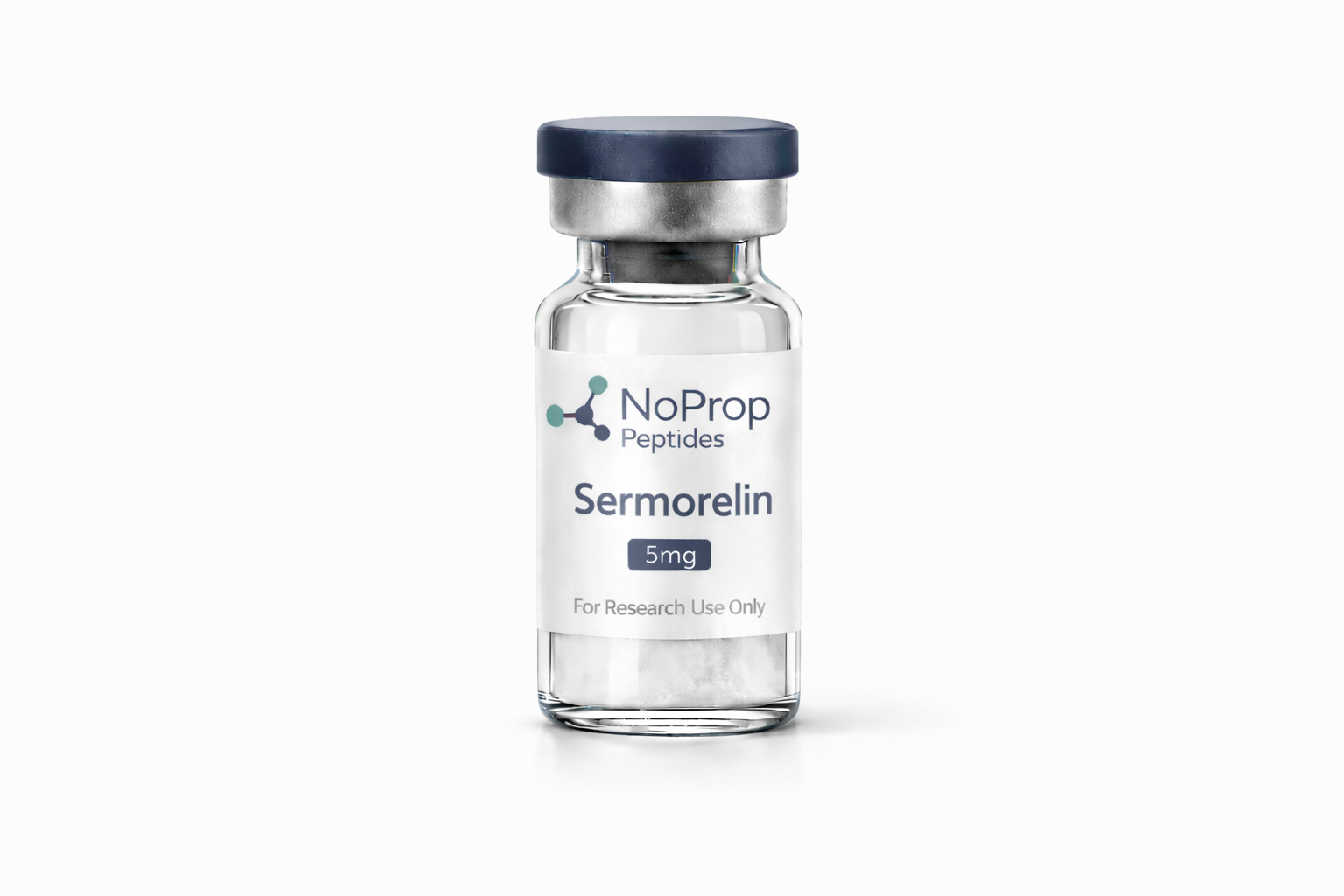
Sermorelin
$49.00
Research-grade Sermorelin acetate. 99%+ purity, third-party tested. 5mg per vial.
Description
Sermorelin (GRF 1-29 NH₂) is a 29-amino acid peptide representing the shortest fully functional fragment of growth hormone releasing hormone (GHRH). Originally developed by Serono Laboratories and FDA-approved in 1997 for diagnostic use, Sermorelin remains one of the most well-characterized GH secretagogues in the research literature — with clinical trial data spanning over two decades.
Research Profile
Sermorelin stimulates the GHRH receptor on pituitary somatotroph cells, triggering endogenous growth hormone synthesis and release. Because it works through the body’s natural feedback mechanisms, GH elevation follows physiological pulsatile patterns rather than the sustained supraphysiological levels seen with exogenous GH administration. Research consistently shows preservation of the hypothalamic-pituitary axis integrity during extended administration periods.
Key Research Areas
- Physiological growth hormone restoration
- Sleep quality improvement (increased slow-wave sleep)
- Body composition optimization in aging models
- Bone density preservation
- Cognitive function and neuroprotection
Specifications
| Sequence | 29-amino acid GHRH fragment (1-29) |
| Molecular Weight | 3357.88 g/mol |
| Purity | ≥99% (HPLC verified) |
| Form | Lyophilized powder |
| Quantity | 5mg per vial |
| Storage | -20°C pre-reconstitution |
Related Research Peptides
Sermorelin operates on the same receptor as CJC-1295 but with a shorter half-life — useful for researchers studying acute GH pulse dynamics. Pair with Ipamorelin for dual-pathway research. See our muscle growth guide.
Research Dosage Protocols
Sermorelin is the shortest GHRH fragment with full GHRH receptor binding activity — amino acids 1–29 of the 44-amino acid native GHRH. Research doses in published animal studies range from 0.3–1mcg/kg subcutaneously, with administration timed to the fasted or sleep-phase equivalent. A 5mg vial reconstituted in 2mL bacteriostatic water yields 2,500mcg/mL. Sermorelin’s 10–20 minute half-life (shorter than Mod GRF 1-29) makes timing of blood collection after administration critical in GH measurement studies. Protocols studying long-term GH axis effects typically run 12–24 weeks, which is longer than most GHRP-only protocols, reflecting Sermorelin’s role in restoring natural pulse architecture rather than forcing acute GH spikes.
Frequently Asked Questions
What is Sermorelin’s FDA history, and why does it matter for research context?
Sermorelin (as Geref) received FDA approval in 1997 for idiopathic growth hormone deficiency in children. It was voluntarily withdrawn from the US market by Serono in 2008 — not due to safety issues but because the commercial market for pediatric GH deficiency was dominated by recombinant GH (Humatrope, Genotropin) which had an established physician preference. The FDA approval and subsequent clinical use generated substantial safety data on long-term GHRH agonism in human subjects. This clinical history distinguishes Sermorelin from purely preclinical peptides and provides a richer safety and pharmacokinetic reference base than most research peptides have.
How does Sermorelin compare to CJC-1295 for GHRH receptor research?
Both are GHRH analogs, but they differ in stability and half-life. Native GHRH (1-44) is cleaved by DPP-IV within minutes; Sermorelin (GHRH 1-29) is slightly more stable but still has a 10–20 minute half-life. CJC-1295 (Mod GRF 1-29) adds four amino acid substitutions that resist DPP-IV cleavage, extending half-life to 30–45 minutes. CJC-1295 with DAC further extends to 6–8 days via albumin binding. For research requiring close mimicry of natural GHRH pulsatility, Sermorelin’s shorter half-life is actually an advantage — it more closely approximates the rapid clearance of endogenous GHRH.
Is Sermorelin’s shorter half-life a research advantage or a limitation?
Both, depending on the study design. As a limitation: Sermorelin requires administration timed precisely with blood sampling windows, and its brief window means missed injection timing significantly impacts GH response data. As an advantage: Sermorelin’s rapid clearance mimics natural GHRH pulses more faithfully than longer-acting analogs. Research studying how the GH axis responds to physiologically-patterned GHRH pulsatility — rather than supraphysiological continuous stimulation — benefits from Sermorelin’s native-like pharmacokinetics. For studies comparing “natural pulsatile” vs. “continuous stimulation” GH secretion effects, Sermorelin is the appropriate tool for the pulsatile arm.