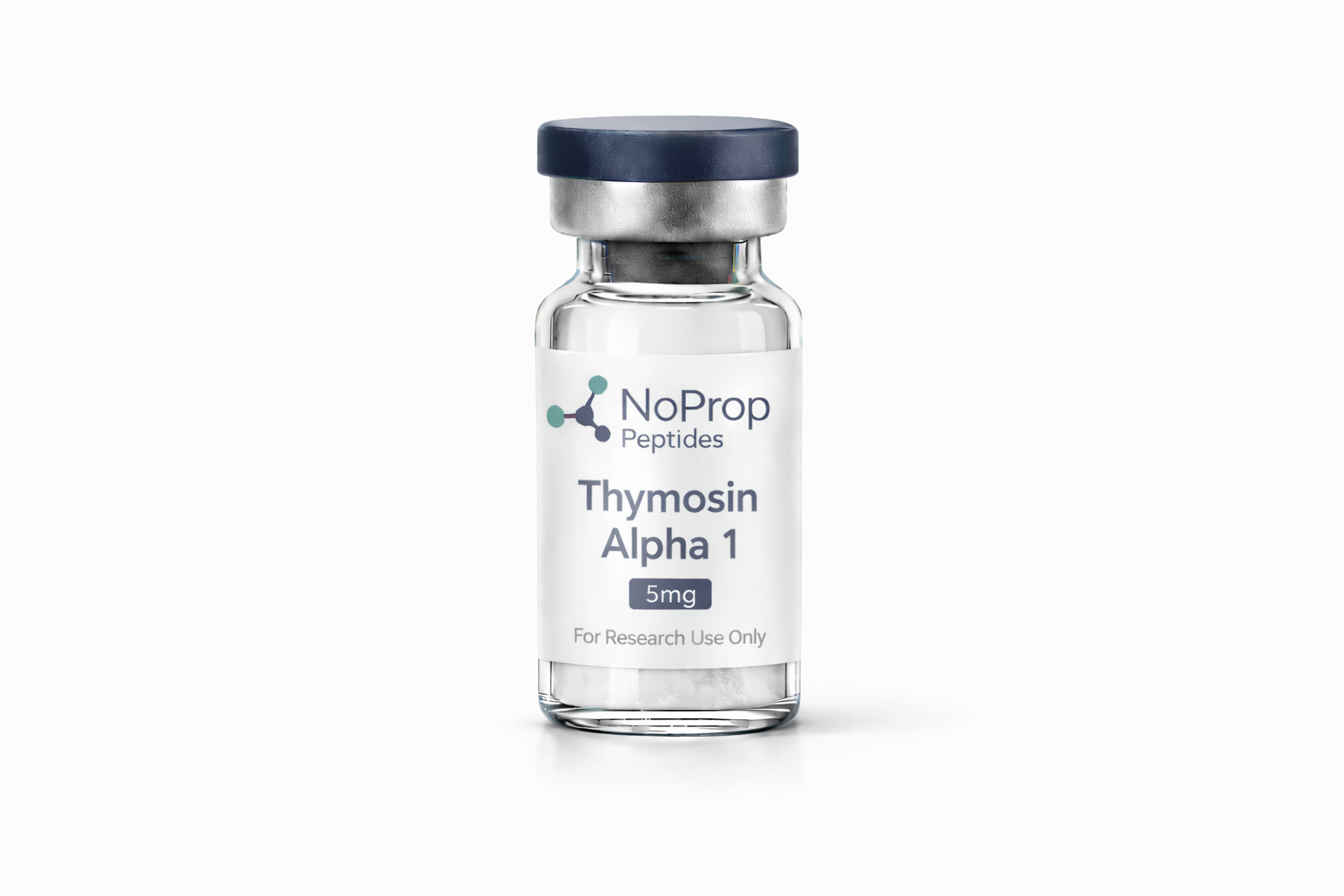
Thymosin Alpha 1
$59.99
Research-grade Thymosin Alpha 1 (Ta1) peptide. 99%+ purity, third-party tested. 5mg per vial.
Description
Thymosin Alpha 1 (Tα1) is a 28-amino acid peptide originally isolated from Thymosin Fraction 5, a preparation derived from bovine thymus glands. Its synthetic version, Thymalfasin, gained regulatory approval in over 35 countries for clinical use — making it one of the few research peptides with extensive human safety data from controlled clinical trials.
Research Profile
Tα1 modulates the immune system through T-cell maturation, dendritic cell activation, and cytokine regulation. Studies published in the Annals of the New York Academy of Sciences demonstrate its ability to restore immune function in immunocompromised models — enhancing T-helper cell response, natural killer cell activity, and antibody production. Unlike immunostimulants that simply amplify immune activity, Tα1 research suggests bidirectional modulation — upregulating suppressed immune function while attenuating overactive inflammatory responses.
Key Research Areas
- T-cell differentiation and maturation
- Dendritic cell activation and antigen presentation
- Viral clearance enhancement
- Vaccine adjuvant potential
- Immune reconstitution in immunosuppressed models
Specifications
| Amino Acids | 28 residues (acetylated N-terminus) |
| Molecular Weight | 3108.27 g/mol |
| Purity | ≥99% (HPLC verified) |
| Form | Lyophilized powder |
| Quantity | 5mg per vial |
| Storage | -20°C pre-reconstitution |
Related Research Peptides
Immune researchers often study Tα1 alongside LL-37 for innate defense and BPC-157 for gut-associated immune function. See our guides on immune peptides and anti-aging peptides.
Research Dosage Protocols
Thymosin Alpha-1 (Tα1) has the most clinically-documented dosing data of any peptide in this category — it is approved and prescribed in over 35 countries. Registered clinical doses are typically 1.6mg subcutaneously twice weekly for immune-related indications, with treatment durations ranging from 4 weeks to 6 months depending on the condition. Research protocols mirror this range. A 1.6mg vial (the standard pharmaceutical presentation from SciClone/Zadaxin) reconstitutes with 1mL sterile or bacteriostatic water. For research-grade lyophilized Tα1 supplied in larger quantities, reconstitute to 1–2mg/mL as a working concentration. Storage post-reconstitution is 2–8°C with a 4-week working window.
Frequently Asked Questions
What does “approved in 35+ countries” actually mean in practical terms?
Thymosin Alpha-1 (as Zadaxin, manufactured by SciClone Pharmaceuticals) has regulatory approval for clinical use across Asia, Latin America, Eastern Europe, and the Middle East — covering countries including China, Italy, Singapore, Philippines, and over 30 others. Approved indications vary by country but include hepatitis B, hepatitis C (as adjunct to interferon), and as an immune adjuvant for some cancer treatments. It is not FDA-approved in the United States, though it has been studied in multiple US clinical trials. The 35+ country approval history provides a depth of real-world clinical safety and pharmacokinetic data that purely preclinical research peptides lack entirely.
What does “bidirectional immune modulation” mean for Thymosin Alpha-1?
Bidirectional modulation means Tα1 can both enhance suppressed immune responses and temper overactive ones — the effect is context-dependent rather than uniformly stimulatory or inhibitory. In immunocompromised states (post-chemotherapy, chronic infection, or aging-related immune decline), Tα1 research shows upregulation of CD4+ T cell activity, natural killer cell function, and dendritic cell maturation. In autoimmune models, research shows Tα1 can enhance regulatory T cell (Treg) activity and suppress excess inflammatory cytokine production. This bidirectional quality is unusual — most immunological compounds push in one direction. It’s the reason Tα1 appears in both cancer immunology and autoimmune research contexts.
What is Zadaxin, and how does it relate to research-grade Thymosin Alpha-1?
Zadaxin is the pharmaceutical brand name for synthetic Thymosin Alpha-1 manufactured and distributed by SciClone Pharmaceuticals. It contains 1.6mg Tα1 per vial, which has become a de facto standard dose reference point. Research-grade Tα1 is the same 28-amino acid sequence, synthesized using solid-phase peptide synthesis, but without pharmaceutical GMP manufacturing controls. Research preparations are available in larger quantities (5mg, 10mg vials) at lower per-milligram cost. For studies referencing Zadaxin clinical data as a baseline, research-grade Tα1 should have HPLC purity ≥99% and ESI-MS molecular weight confirmation to ensure sequence integrity.
What research dosing protocols are most commonly used?
Research protocols largely parallel the clinical Zadaxin dosing: 1–3mg subcutaneously, administered twice weekly. Some studies examining acute immune stimulation use single higher doses (3–6mg) to capture peak immune activation markers. Chronic immune support protocols typically run 4–12 weeks. Unlike most research peptides where preclinical dosing involves scaling from animal studies, Tα1 has the advantage of extensive human pharmacokinetic data — plasma half-life is approximately 2 hours after subcutaneous injection, peak plasma concentrations occur at 30–60 minutes, and effects on immune markers are measurable within 24 hours of administration.
How does Thymosin Alpha-1 differ from Thymosin Beta-4 (TB-500)?
Despite sharing “thymosin” in the name, Alpha-1 and Beta-4 are structurally unrelated and serve entirely different biological functions. Thymosin Alpha-1 is produced in the thymus gland and primarily governs T cell maturation and immune system activation — its research focuses on infectious disease, cancer immunology, and immune restoration. Thymosin Beta-4 (of which TB-500 is a fragment) is expressed ubiquitously in most cell types and regulates actin polymerization — its research focuses on tissue repair, wound healing, and cardiovascular regeneration. They are two different proteins from the same “thymosin” family named historically before their distinct functions were characterized.
What are the reconstitution and storage parameters for Thymosin Alpha-1?
Tα1 reconstitutes easily in bacteriostatic or sterile water. Add 1mL to a 5mg vial for 5mg/mL. Allow to dissolve with gentle rolling — typically 2–3 minutes. Store refrigerated at 2–8°C; working stability is 4–6 weeks. Lyophilized powder at -20°C retains potency for 24+ months. Tα1 is relatively robust compared to more complex peptides — its 28-amino acid linear structure (no disulfide bonds, no complex secondary structure) means it’s less prone to aggregation and oxidative degradation. Pharmaceutical Zadaxin vials are stored at room temperature below 25°C, suggesting the lyophilized form is quite stable; reconstituted research solutions should still be refrigerated.
For research and laboratory use only. Not for human consumption. All peptides are sold strictly as research chemicals.