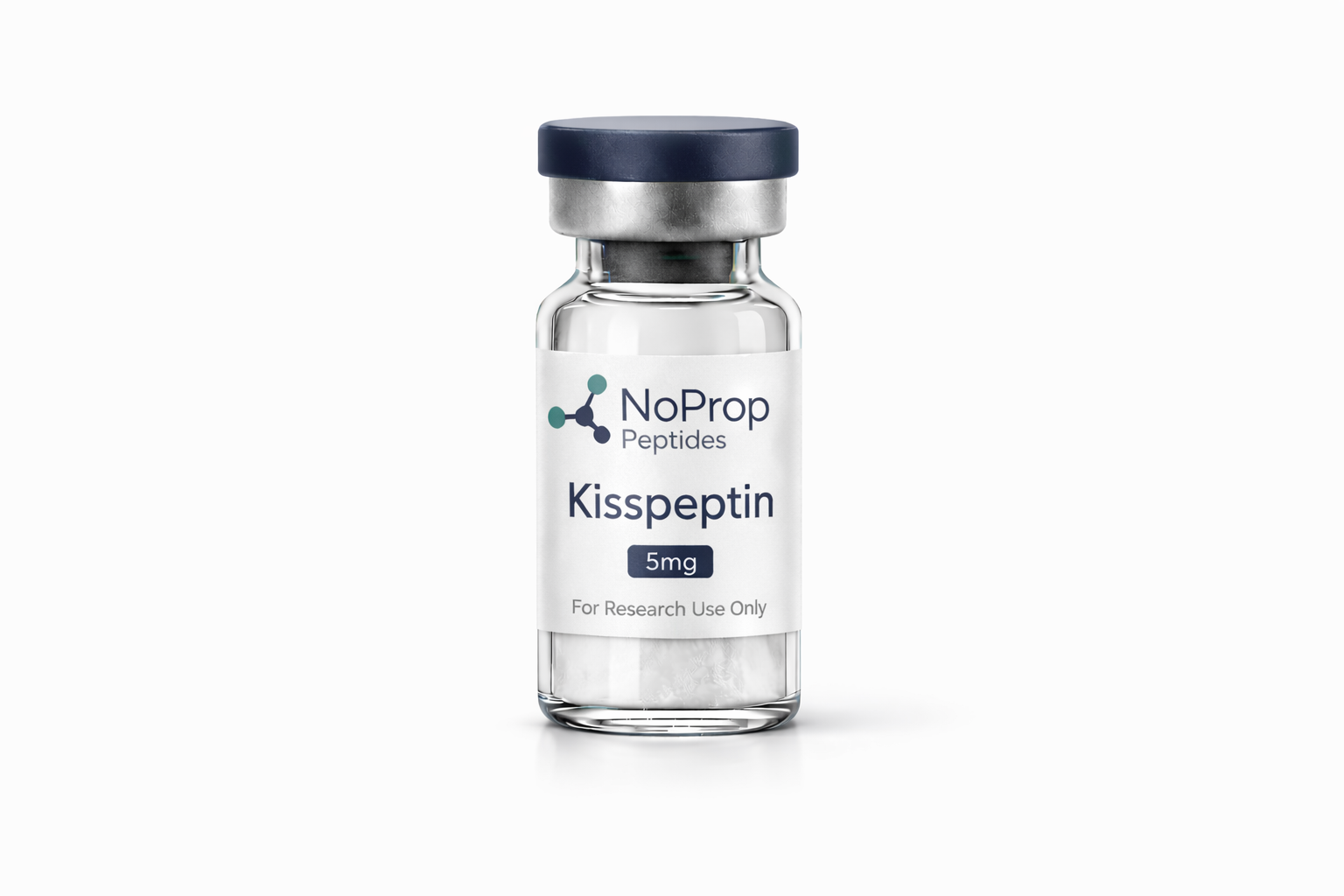
Kisspeptin
$54.99
Research-grade Kisspeptin-10 peptide. 99%+ purity, third-party tested. 5mg per vial.
Description
Kisspeptin is a neuropeptide encoded by the KISS1 gene, originally identified in 1996 at Penn State University (in Hershey, Pennsylvania — hence the “kiss” name, after Hershey’s Kisses). Kisspeptin-10 is the minimal bioactive fragment, consisting of the C-terminal 10 amino acids that retain full receptor binding activity at the GPR54 (KISS1R) receptor.
Research Profile
Kisspeptin sits at the top of the reproductive hormonal cascade — it stimulates GnRH (gonadotropin-releasing hormone) neurons in the hypothalamus, which triggers LH and FSH release from the pituitary. Research published in the New England Journal of Medicine and Journal of Clinical Investigation established Kisspeptin as the “master regulator” of the HPG axis. Loss-of-function mutations in the KISS1R gene cause hypogonadotropic hypogonadism, confirming its essential role in reproductive signaling.
Key Research Areas
- GnRH neuron activation and HPG axis regulation
- LH pulse stimulation in both sexes
- Puberty onset signaling mechanisms
- Reproductive hormone restoration in deficiency models
- Testosterone production pathway research
Specifications
| Type | Kisspeptin-10 (C-terminal decapeptide) |
| Molecular Weight | 1302.48 g/mol |
| Purity | ≥99% (HPLC verified) |
| Form | Lyophilized powder |
| Quantity | 5mg per vial |
| Storage | -20°C pre-reconstitution |
Related Research Peptides
Kisspeptin addresses hormonal signaling upstream of reproductive function. For melanocortin-pathway sexual health research, see PT-141. Complete overview at our sexual health peptides guide.
Research Dosage Protocols
Kisspeptin research uses substantially different dose ranges depending on the administration route and endpoint. Intravenous bolus doses in human LH pulse studies have used 0.1–10nmol/kg, with LH responses measurable within 30–60 minutes. Subcutaneous doses studied in reproductive endocrinology research range from 1–100nmol/kg. For Kisspeptin-10 (the most commonly used form in research), a 5mg vial reconstituted in 2mL bacteriostatic water yields 2,500mcg/mL. The short half-life (Kisspeptin-10: ~28 minutes IV) means intravenous infusion protocols rather than bolus injection are preferred in studies requiring sustained GnRH pulse stimulation. Kisspeptin’s potency means volume calculations should be verified carefully.
Frequently Asked Questions
Why is it called Kisspeptin — is there a story behind the name?
Yes — Kisspeptin was discovered in 1996 by researchers at Pennsylvania State University’s Hershey Medical Center. The protein was named “KiSS-1” after the city of Hershey, Pennsylvania (home of Hershey chocolate), in keeping with a lab tradition of whimsical naming. KiSS-1 was initially identified as a metastasis suppressor gene in melanoma research. The peptide product of the KiSS-1 gene was later called Kisspeptin. The connection to reproductive biology came a decade later when Kisspeptin’s role in activating GnRH neurons was discovered. The name stuck despite the chocolate reference having nothing to do with the peptide’s reproductive neuroendocrine function.
What is GPR54, and how does Kisspeptin activate it?
GPR54 (also called KISS1R) is a G-protein coupled receptor expressed predominantly in the hypothalamus, pituitary, and gonads. When Kisspeptin binds GPR54, it activates Gq/11 signaling, which increases intracellular calcium and activates phospholipase C. In GnRH neurons (located in the hypothalamic arcuate and anteroventral periventricular nuclei), this calcium-mediated activation triggers action potential firing and GnRH secretion. GPR54 is considered the master switch for reproductive axis activation — without functional GPR54, the entire HPG axis remains silent. Humans and animals with inactivating GPR54 mutations have hypogonadotropic hypogonadism and never undergo puberty.
How does Kisspeptin connect to GnRH, LH, and FSH?
Kisspeptin activates GnRH neurons in the hypothalamus → GnRH travels via portal circulation to the anterior pituitary → pituitary gonadotrophs release LH (luteinizing hormone) and FSH (follicle-stimulating hormone) in response → LH and FSH act on gonads (testes or ovaries) to drive testosterone/estrogen production and gametogenesis. Kisspeptin is positioned at the top of this cascade — it’s the gatekeeper that determines whether GnRH pulses happen at all. This makes Kisspeptin one of the most upstream modulators of reproductive function identified, and explains why it’s a key target in research on puberty timing, fertility, and sex hormone regulation.
What is the difference between Kisspeptin-10 and the full-length Kisspeptin-54?
The KISS1 gene produces a 145-amino acid prepropeptide that’s cleaved to produce multiple shorter fragments. The full-length primary active form circulating in human plasma is Kisspeptin-54 (54 amino acids). Kisspeptin-10 is the C-terminal 10-amino acid fragment (the amide form). Both fragments contain the C-terminal Arg-Phe-amide motif required for GPR54 binding. Kisspeptin-10 is used in research because it’s cheaper to synthesize, easier to handle, and retains full GPR54 binding activity. Kisspeptin-10 actually has a shorter half-life than Kisspeptin-54, which can be an advantage (for short pulse studies) or disadvantage (sustained infusion studies).
How quickly is an LH response observed after Kisspeptin administration?
In human intravenous bolus studies, LH begins rising within 15–20 minutes of Kisspeptin-10 injection, peaks at approximately 30–60 minutes, and returns to baseline by 2 hours. The response is rapid because Kisspeptin is triggering GnRH neurons that already contain GnRH stores — no new synthesis is required for the acute LH pulse. Subcutaneous administration produces a slightly delayed but sustained LH response compared to IV bolus. FSH response is less dramatic in acute studies — FSH secretion is more sensitive to GnRH pulse frequency than amplitude, and a single Kisspeptin bolus primarily tests amplitude response.
How do I reconstitute Kisspeptin-10 for research?
Kisspeptin-10 typically comes in smaller vials (1–5mg) given its potency. Add 1mL bacteriostatic water to a 5mg vial for a 5,000mcg/mL stock. For IV research requiring very precise low doses in the nmol/kg range, further dilution in saline to a 100–500mcg/mL working concentration provides better volume precision. Kisspeptin-10 dissolves readily. Store reconstituted solution at 2–8°C with a 4-week working window. For studies requiring multiple infusion rates across animal groups, prepare a single master stock and dilute to working concentrations immediately before each experiment to minimize variability from differential degradation between vials.
For research and laboratory use only. Not for human consumption. All peptides are sold strictly as research chemicals.